Correspondent

Nagaland chief minister Neiphiu Rio on Tuesday presented a tax-free deficit budget of Rs. 2212.74 crore for the financial year 2022-23, even as the current year’s transaction for the year 2022-23 was estimated to result in a positive balance of Rs. 150.30 crore.
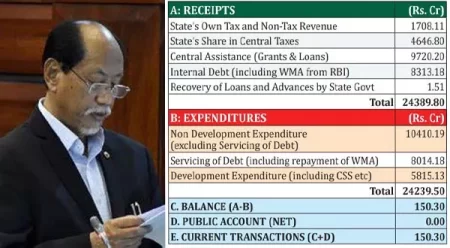
Rio, who holds the finance portfolio, presented the State Budget with gross receipts estimated at Rs 24,389.80 crore and gross expenditure at Rs 24,239.50 crore for the financial year 2022-23 on the third day of the Budget Session.
Though transactions for the year 2022-23 were estimated to result in a positive balance of Rs 150.30 crore, Rio said the fiscal was estimated to close with a negative balance of Rs 2,212.74 crore due to the negative opening balance of Rs 2,363.04 crore. (See table)
In his 15 paged budget, he informed the House that during the current fiscal the State’s share of Central taxes was increased in the revised estimates of the Union Budget by Rs 547.10 crore due to growth of the country’s economy.
He said that the State’s own revenues were estimated to improve by Rs 42.45 crore, adding that in view of these improvements, 2021-22 was estimated to close with a deficit of Rs 2,363.04 crore as against the earlier budget estimate of Rs 2,679.46 crore. Rio acknowledged that despite all efforts, the State was deeply affected by pandemic as it caused a huge shortfall in receipts.
Even before the pandemic, he said the State had already suffered a shortfall of Rs 925.42 crore in receipts in 2019-20, resulting in a huge deficit. And 2020-21 too saw a huge shortfall in receipts to the tune of Rs 1,341.99 crore over what was reflected in the Union Budget for the State in the share of Central taxes and duties due to the pandemic.
Facing such difficult circumstances, he mentioned that the State government was compelled to resort to drastic measures to avert a financial collapse and took steps like pro-rata cuts of both developmental and non-developmental expenditure, put a halt on filling up of retirement vacancies and banned purchase of vehicles.
He claimed that these measures had enabled the State to continue functioning and fulfilled most of the budgetary commitments, adding that improvement in the finances was witnessed due to these austerity measures, coupled with increased receipts in the share of Central taxes and improvements in its own revenue receipts.
However, in view of the huge losses incurred during the last two years, he stressed that it had become necessary to continue with the austerity measures to help stabilise the finances.
Further, Rio that the government had also taken various measures to enhance State’s own revenues and increase the resources. He said, following a comprehensive review of various departments that collected both tax and non-tax revenue by a committee, measures had been proposed for enhancement of rates, fees and duties, including measures to enhance efficiency, which included departments like Power, Water Supply, Stamps, Transport, Geology & Mining, Forests & Environment, Land Revenue, Transport, PWD (H) and Excise.
He informed that the State cabinet had already accepted the recommendations and instructions had been issued to all concerned to put the new measures in place, while the government was also actively exploring the guarantee route to help access funds outside the budget to fund critical developmental and infrastructure activities to supplement the limited resources.
For this, he said a special purpose vehicle was being formed. He said the government had created a comprehensive database of all its employees called the Personnel Information Management System (PIMS), which would help ensure collection of real-time data of all categories of employees, including personal data like date of entry into service and date of retirement.
He asserted that the database would also form the basis for budgetary allocation to various departments for salaries and wages and would help to put a check on illegal and excess appointments beyond the sanctioned strength that was becoming a widespread problem.
In addition, he said the Finance Department has recently introduced e-Pay Bill at DDO level to ensure that salaries were prepared as per actual staff strength as reflected in the PIMS database. Eventually, he said the e-Pay Bill would help the Finance Department to get real-time data on cash outgo and check fraudulent payments and other financial malpractices that were frequently being reported by Comptroller and Auditor General of India.
These measures would go a long way in bringing about transparency and accountability, and prevent malpractices and leakage of public funds, he added.
Rio said despite the difficult times, the last few months had shown a substantial turnaround in the State’s economy.
According to him, the country’s GST collections had reached Rs 1,40,986 crore during in 2022 and State’s own revenues also showed a healthy increase. As a result, he said he was in a position to allocate Rs 775 crore for the State Development Outlay for 2022-23 and it represented an increase of 10.71% over last year’s outlay.
In the State Development Outlay for 2022-23, he mentioned that efforts had been made to ensure that priority was given to completion of ongoing projects and to projects that had a multiplier effect in creating livelihoods and local economies.
He said Rs 225.85 crore of development fund was earmarked for various departmental activities, including core activities, while Rs 151.08 crore was earmarked for construction of office buildings or residential quarters and Rs 122.06 crore for road and other infrastructure-related activities.
A higher amount of Rs 276 crore had been earmarked for State’s share to CSS to facilitate access to more Central funds, out of which 30% of the allocation was being provided upfront to the CSS implementing departments to be reflected in their Demands for Grants of 2022-23, Rio said, adding that this would enable the departments to get their first instalments early and thereby improve implementation of the schemes.
Highlighting the various allocations made by the government, Rio said that keeping in mind the importance of the Foothill Road, the government made a provision for Rs. 30 cr during the current financial year. He said once the tender formalities are completed and works commence, funds shall be released.
He also said that preparation of DPR for the East-West Highway, running from Showuba-Zunheboto-Shamator-Noklak-Pangsha, and for the Trans Eastern Highway from Mon-Longwa-Pangsha-Kiphire-Avangkhu was already initiated by the state government along with NHIDCL.
Further he said the government has completed the construction of two towers for staff quarters at Dwarka and will start the re-development of the Nagaland House at A.P.J. Abdul Kalam Road on EPC (Engineering Procurement and Construction) mode. Rio said he intended to provide an iconic building which will be one of the landmark in Delhi.
Through the ‘Special Assistance to States for Capital Expenditure’ in the form of interest free loan for a period of 50 years, the Government of India in the budget announced the allocation of Rs. 1.00 lakh crore for the scheme for 2022-23, to this Rio proposed to supplement activities under the sectoral allocations or take up specific projects during the year, some of which include– providing access to remote and rural areas, improve facilities in the District and Administrative Headquarters; completion of a football stadium at Chumukedima Police Complex; Development of a Heritage Complex at Mon; Re-development of the Dimapur Town Hall; Construction of an indoor multipurpose-cum-wrestling stadium with a capacity of 15,000 to 20,000 at Kohima.
To establish a separate High Court in the State, he said he will explore avenues for financing to speed up the construction works at the new High Court Complex, including through the Special Assistance to States for Capital Expenditure.
Keeping in mind that Nagaland being power deficient state and having to purchase power from outside Rio provided an outlay of Rs. 18.03 crore to the Power sector with special emphasis on projects aimed at exploiting the potential for generation of power in the state.
Rio exuded confidence that the state shall not only become self-sufficient in power but will also be in a position to export surplus power and earn revenue once these projects materialize.
RELATED POSTS
View all