

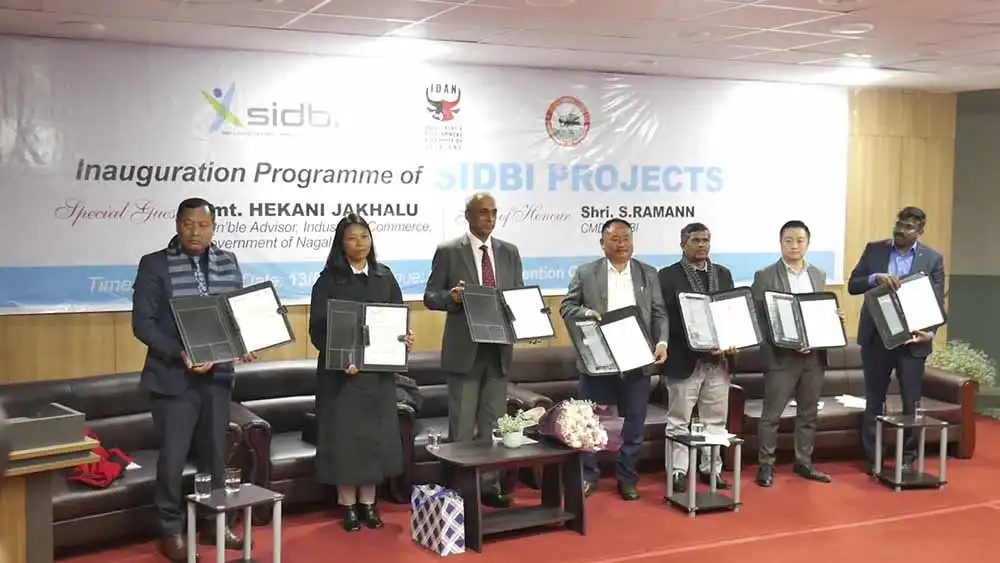
Small Industries Development Bank of India’s (SIDBI) Swavalamban Connect Kendras (SCKs) and sports scholarship were launched at Capital Convention Centre here on Monday, along with the announcement of SIDBI Cluster Development Fund (SCDF). Speaking on the occasion, Industries and Commerce adviser Hekani Jakhalu recalled that back in 2011 when the concept of entrepreneurship was relatively new in Nagaland and the people were predominantly focused on government jobs, the state government had supported “Who Will Rajeev Chandrasekhar Choose” programme to promote entrepreneurship.
She claimed that the government aimed to shift the mindset of young individuals towards business over the past decade through capacity building, despite challenges such as limited access to credit facilities.
She said she was happy at the visit of SIDBI chairman-cum-managing director S Ramann, and expressed state government’s willingness to collaborate with the bank. She claimed that chief minister Neiphiu Rio emphasised nurturing local entrepreneurs for the state’s economic growth.
Disclosing that over 20,000 Udyam registrations had been completed in the state under the micro, small & medium enterprises (MSME) sector, she emphasised awareness before applying for any scheme.
She said 14,500 self-help groups (SHGs) were there in the state, and that efforts were required to facilitate their growth.
In his speech, Ramann noted that the people of Nagaland possessed education, which was a major advantage, adding that success in various aspects would naturally follow due the head start that education provided. He also shared his experiences of dealing with banks and advocated establishment of SKCs in all districts and stressed effective communication between the SKCs and the people. Regarding seed stage funding, Ramann expressed willing to support Investment and Development Authority of Nagaland’s (IDAN) incubation centre, but cautioned that seed capital was not free money.
Speaking on the necessity for banking and credit services in Nagaland, especially in remote and newly-established districts, commissioner Mhabemo Yanthan said access to these services was not merely a matter of convenience, but a fundamental requirement for socio-economic development in any region.
Principal secretary and development commissioner Ramakrishnan shared the significant progresses in developing social infrastructure and industrial investments, with plans for even more in the upcoming year. He also mentioned about the ongoing collaborations with various stakeholders and expressed the willingness to work closely with SIDBI. In a state where land was predominantly owned by the communities, he said the state government faced challenges in providing land to investors. To address this issue, he revealed that the government was considering the creation of a land bank that would allow potential investors to utilise it in the future.
He mentioned that investors from outside the state often expressed willingness to invest, but a key hurdle was power supply. He said against a peak demand of 180 MW, the state currently produced only 20 MW, and referred to the untapped potential in the power sector.
SIDBI chief general manager Dr SS Acharya, claimed that the SCKs in 16 districts of Nagaland would serve as comprehensive support centres for entrepreneurs and guide individuals through the entire process. Further, he mentioned that the SIDBI had made a commitment for Rs 100 crore initially for the establishment of common facility centres (CFCs) and other industrial infrastructure to benefit MSMEs through the SIDBI Cluster Development Fund.
Acharya informed the gathering that SIDBI was also extending sports scholarships through the Nagaland Olympic Association (NOA) to support five promising athletes from the state, with a starting fund of Rs 5 lakh to be provided for their training. Additionally, he said SIDBI had entered into a memorandum of understanding (MoU) stipulating that, as incubation centres materialised, it would establish a seed fund to aid entrepreneurs in their business journey.