

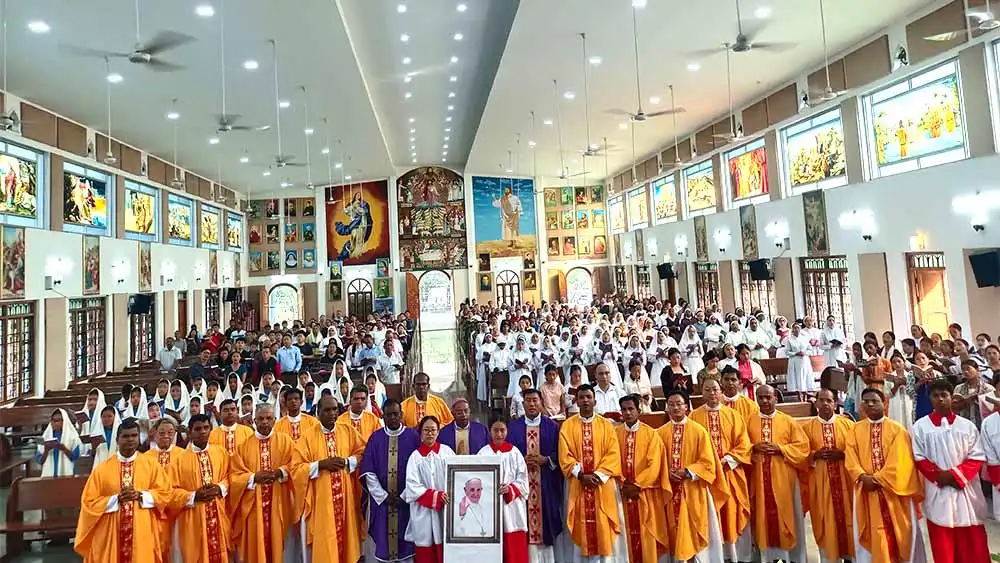
The Third Diocesan Requiem Mass for the late Pope Francis was celebrated on Saturday, at St. Joseph’s Church, Chümoukedima.
Faithful gathered to mourn and honour the life and legacy of the Pope, who passed away on April 21 during the 12th year of his papacy, leaving a profound void in the Catholic Church and the world.
Reflecting on his life, Pope Francis—born Jorge Mario Bergoglio—was a pontiff marked by several historic “firsts.” Elected on March 13, 2013, he was the first Jesuit pope, the first from Latin America, and the first non-European pope in over 1,300 years. His election followed the unprecedented resignation of Pope Benedict XVI. As the Church’s first “digital Pope,” he used social media extensively, reaching millions worldwide.
Pope Francis’s papacy was distinguished by his emphasis on mercy, compassion, and humility. His Eminence Oswald Cardinal Gracias, Archbishop Emeritus of Mumbai and a close advisor to Pope Francis, remarked that the Holy Spirit had sent the right leader for the time. “He preached the Gospel undiluted, remaining fearless and faithful,” Cardinal Gracias said, highlighting the Pope’s integrity, compassion for the marginalized, and unwavering commitment to prayer and justice.
The editorial director of L’Osservatore Romano noted that mercy was the central theme of Pope Francis’s pontificate. “Mercy is the air we breathe,” the Pope often said, emphasizing forgiveness and compassion as essential to Christian life.
Iconic Messages and Legacy
Pope Francis’s pontificate left a treasury of memorable phrases and guiding principles:
“Don’t forget to pray for me” became his familiar closing to public addresses.
“Welcome, protect, promote, and integrate” were his guidelines for addressing the global migration crisis.
He tirelessly called for peace amid global conflicts, advocating for “honourable compromises” and opposing the arms trade.
During the COVID-19 pandemic, his message of unity and hope resonated deeply: “We are all in the same boat, fragile yet important, called to row together.” He denounced the “throwaway culture” of consumerism and exploitation, emphasizing the dignity of the poor, the elderly, migrants, and the unborn.
He envisioned the Church as a “field hospital after battle,” advocating for nearness and healing over judgment and exclusion.
Among his pastoral teachings, he urged clergy to carry “the smell of the sheep,” encouraging closeness to the faithful. He promoted a “more widespread and incisive” presence of women within Church leadership, appointing women to high-ranking positions in the Vatican Curia. He also advised married couples to cherish three simple yet profound words: “Please, thank you, and I’m sorry.”
Commitment to the Marginalized
Pope Francis’s concern for the poor and migrants was a consistent hallmark of his leadership. He established the annual World Day of the Poor and frequently shared meals with the homeless. He advocated for bridge-building over wall-building, promoting dialogue, inclusion, and solidarity across religions and cultures.
Death: A New Beginning
In his final reflections, Pope Francis expressed that death is not an end, but a “new beginning”—a transition into eternal life with God. This message of hope was echoed in his writings and speeches, offering consolation to millions grieving his loss.
Throughout his 12-year papacy, Pope Francis transformed the tone and image of the Catholic Church, bringing it closer to the Gospel values of love, mercy, and humility. His leadership reshaped the Church’s global engagement without altering its core doctrines, fostering a more compassionate and inclusive spirit that will continue to inspire generations to come.