

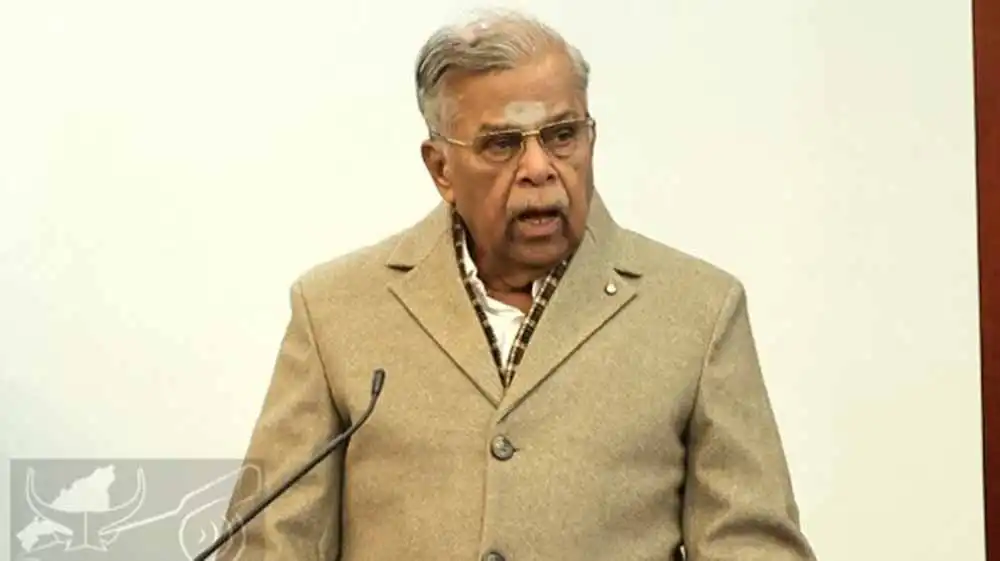
Nagaland Governor La Ganesan has called upon all stakeholders to overcome their differences and any other remaining obstacles, and thrash out a final Naga solution in the “spirit of give and take”.
In his customary address on the opening day of the fourth session of 14th Nagaland Legislative Assembly (NLA) that began here on Monday, the governor said the state government was mindful of the unresolved Naga political Issue, which had been one of the major constraints in the pursuit of development and welfare goals.
He admitted that it had been the cherished dream of everyone in Nagaland for the last many years to witness the final solution to the Naga political issue, and to live and work in a peaceful environment. He reiterated the government’s will continue to give top priority to peaceful resolution of the Naga political issue, assuring to take every possible step in furthering and strengthening the ongoing peace process, and in playing the role of active and constructive facilitator.
He thanked the legislators for their unflinching commitment to the peaceful and early resolution of the Naga political Issue and for coming together to form an opposition-less government to facilitate an early resolution in the larger interest of the people.
He declared that the government was ready to pave the way for the final solution that was honourable, acceptable, and inclusive.
Referring to the suspension of the Free Movement Regime (FMR) along the Indo-Myanmar border, he acknowledged the historical, tribal, and familial ties that traversed international boundaries. He called for reconsideration of the decision, advocating continuation of FMR with enhanced regulations, including input from village council authorities, to ensure smooth implementation.
He acknowledged the resounding mandate of the people of Nagaland as the state government approached its first year in office, stressing public cooperation for the government to redouble the latter’s efforts towards realising its vision for comprehensive and holistic development.
Ganesan said that the state government gave paramount importance to nurturing and developing human resources, and recognise the immense potential inherent in Nagaland’s demographics.
To ensure the educational system remained dynamic and responsive to evolving trends, he cited various interventions initiated by the Department of School Education, including bolstering education management information systems, implementing a teacher attendance monitoring system, and establishing professional learning communities for continuous professional development.
Ganesan said the government was focused on enhancing the overall teaching and learning environment by constructing 16 school complexes based on a hub and spoke model, known as the Lighthouse School Complexes. Quality assurance had been integrated into higher educational institutions, with commendable progress reflected in the accreditation of colleges by the National Assessment and Accreditation Council (NAAC).
He mentioned that efforts were underway to obtain accreditation from the National Board of Accreditation (NBA) for polytechnic institutes and upgrade three diploma institutes to degree engineering.
Disclosing that the government was actively pursuing the establishment of an Indian Institute of Science Education & Research in Nagaland in collaboration with the Central government, he said the endeavour aimed at elevating the state’s higher education landscape, promote science and mathematics education, and foster research initiatives. He pointed out that the acquisition of 200 acres of prime land in Sukhovi, Chümoukedima district, underscored the government’s commitment to this initiative.
Ganesan also recounted the remarkable achievements of Nagaland’s youth in the sporting arena, noting their consistent success at national and international levels.
To further cultivate a vibrant sporting culture and position the state as a leading sporting power, he said the government had implemented several critical interventions in the field of sports.
He reiterated the government’s commitment in bolstering infrastructure and cultural prominence, pointing out how the Department of Youth Resources and Sports spearheaded the construction of five pre-fabricated multi-discipline sports stadiums last year, with 11 more underway. Among these endeavours, he stated that most notable was the development of a FIFA-standard football stadium with synthetic turf and floodlights at NAPTC, Chümoukedima, enhancing opportunities for athletes and positioning Nagaland as a host for major sporting events.
He also lauded the state’s music and arts scene with events like the Hornbill Music Festival garnering international attention. He mentioned that that festival, which attracted 40 bands and 800 musicians from five countries in its 2023 edition, boasted a social media impact exceeding 10 million.
According to him, the recent Asia Music Summit (AMS) at Kohima that attracted participants from over 12 countries and 510 registered delegates solidified the state’s reputation as a cultural powerhouse.
Emphasising infrastructure development, the governor highlighted ongoing efforts to enhance road connectivity and logistics. He revealed that the PWD (R&B) and PWD (NH) successfully upgraded over 1021.63 km of roads in the previous fiscal year, with plans to construct and improve more than 1032 km in the current year. He said the initiatives included the proposed Foothills Road (Trans-Nagaland Highway), spanning 364 km and traversing seven districts, to invigorate economic activities in mineral-rich region.
He said the state government was actively advocating construction of an airport at Ciethu, near Kohima, aiming to overcome constraints in air connectivity. Proposals had been submitted to the Ministry of Civil Aviation for an airport capable of accommodating ATR-72 class aircraft initially, with provisions for future expansion. Additionally, he said the entry of Pawan Hans into Nagaland promised to bolster helicopter services, catering to six locations in the state and facilitating inter-state connectivity with Jorhat Airport.
Ganesan commended the substantial progress witnessed in power infrastructure over the past few years. In the generation sector, proposals for projects such as the Lower-Tizu 42MW HEP and Zungki 24MW HEP had obtained clearances from various ministries of the Government of India and were now awaiting funding from the Asian Development Bank (ADB).
In the transmission sector, comprehensive coverage of major towns and load centres with a robust 132kv line system had been achieved under the World Bank-funded NE Region Power System Improvement Scheme (NERPSIP). The sub-transmission and distribution sector witnessed continuous upgradation and strengthening efforts, with plans underway to implement the Revamped Distribution System Scheme (RDSS) aimed at addressing sectoral requirements.
To enhance revenue collection efficiency, he said the government planned to deploy smart pre-paid meters on a large scale, thereby reducing purchase-collection gaps and curbing leakages.
He emphasised the state’s commitment to fostering entrepreneurship and industrial growth, with initiatives such as the State Export Promotion Strategy, establishment of State Export Facilitation Committee, and District Export Promotion Committees aiming to create an enabling environment for industries.
He mentioned that the Chief Minister’s Micro Finance Initiative (CMMFI) provided loans to entrepreneurs in all the districts, supplemented by financial assistance from the Chief Minister’s Corpus fund.
Moreover, under the State Startup Policy, Entrepreneurship Development Centres (EDC) had been established to promote innovation and enterprise among the youth. Collaborating with SIDBI, he said that the state had embarked on a transformative journey by entering into four MoUs aimed at catalysing economic growth, promoting MSME development, and establishing Swavalamban Connect Kendras (SCKs) and startup seed funding mechanisms.
The governor mentioned that the Department of Industries and Commerce was spearheading establishment of Modern Aggregation Centres and an Integrated Warehousing and Distribution Centre, aimed at enhancing the logistics sector and promoting employment generation. He said the proposed Unity Mall at District Industries Centre Complex would provide local artisans and entrepreneurs with a platform to showcase and sell their products, fostering economic empowerment and community development.
He said Nagaland secured a commendable position as one of the “Fast Movers” in the “Logistics Ease Across Different States (LEADS) 2023” report of the Ministry of Commerce & Industry, acknowledging the state’s strides in infrastructure and logistics enhancement.
With a two-fold increase in food grain production witnessed over the past two decades, he said the state positioned itself as a producer of organic agricultural products. During the International Year of Millet in 2023, MoUs were signed between farmer producer companies and Bright Coop Agro, Kolkata for supply of organic foxtail millets. Additionally, under the PM-KISAN initiative, more than two lakh farmers had directly benefited, with substantial financial support credited to their bank accounts.
Efforts in soil and water conservation under Rashtriya Krishi Vikas Yojana aimed to mitigate soil erosion and enhance water conservation. The Jal Jeevan Mission provided over three lakh functional household tap connections, improving access to clean water across rural areas.
In the horticulture sector, he said the expansion of various crops and the implementation of micro-irrigation systems under PMKSY reflected the state’s commitment to agricultural diversification and modernisation. Projects under the North Eastern Council (NEC) aimed to strengthen post-harvest management and promote exotic fruit crops through scientific technology adoption.
With the establishment of regional training centres and veterinary hospitals to bolster veterinary health services across the state, the Animal Husbandry & Veterinary Department focused on skilling and capacity building.
The governor claimed the fisheries sector continued to witness growth with the creation of circular hatcheries and water bodies under the Pradhan Mantri Matsya Sampada Yojana, benefiting fish farmers. Sericulture also contributed significantly to employment generation in the state.
The Department of Rural Development’s initiatives under MGNREGS and the Nagaland State Rural Livelihoods Mission (NSRLM) aimed to alleviate poverty and empower rural communities through self-help groups and livelihood programs.
He mentioned that efforts to address regional disparities through the Border Area Development Programme (BADP) and Underdeveloped Areas Programme (UDAP) underscored the government’s commitment to inclusive growth and development.
He said that the inauguration of Nagaland Institute of Medical Sciences & Research (NIMSR) with ongoing efforts for its expansion and upgradation was a milestone.
Governor further said that the Nagaland Municipal Act, 2023 reflected the government’s commitment to grassroots governance and urban development.
He noted the significant urban growth, necessitating proactive measures for comprehensive development. He said the passage of the Nagaland Municipal Act, 2023, showed the commitment to grassroots governance.
As Nagaland progressed on its developmental trajectory, Ganesan emphasised unity, urging the people to cherish their shared history and foster a sense of brotherhood.
He commended ongoing efforts to enhance urban infrastructure, citing progress in the Pradhan Mantri Awas Yojana and the Smart City Mission. Kohima’s inclusion in the top tier of Smart Cities reflected commendable advancements in urban landscape transformation.
Additionally, plans for Nagaki City demonstrated the state’s forward-looking approach to urban planning and expansion.
Noting Nagaland’s rich biodiversity and the strides made in environmental conservation, he said the Department of Environment, Forest, and Climate Change’s efforts, including afforestation projects and the celebration of a decade of Amur Falcon conservation, reflected the government’s commitment to preserving natural heritage.
Acknowledging the peaceful atmosphere and effective law enforcement, the governor praised the collective efforts of the district administration, police, security agencies, and tribal bodies. Initiatives such as the inauguration of the Yimpang Platoon post and the “War on Drugs” signified ongoing endeavours to maintain law and order.
On the economic front, he highlighted the growth in GST collection, signalling a robust economy. He disclosed that the overall GST target was Rs 1,397.94 crore in the current financial year, and Rs 995.35 crore had already been collected, as per the December 2023 figures.
However, he called for further efforts to enhance revenue collection to meet the state’s evolving needs.
Ganesan appealed to the legislators to prioritise public welfare in their deliberations and actions. Calling for sustained efforts to ensure equitable development across the state, he urged the members to remain vigilant and proactive in addressing public concerns.
Meanwhile, the motion of thanks on the Governor’s address was moved advisor for Labour and Employment, Skill Development, Entrepreneurship and Excise, Moatoshi Longkumer and seconded by advisor for IT & Communication, Economics & Statistics, Evaluation Sethrongkyu Sangtam.
The List of Business for the first day included an obituary reference to former Nagaland Governor late PB Acharya, by chief minister Neiphiu Rio, while NLA Speaker Sharingain Longkumer made the obituary reference to Manohar Gajanan Joshi, former Speaker of Lok Sabha and former chief minister of Maharashtra; and former members, Hokheto Sema, SK Sangtam and L Khumo.