

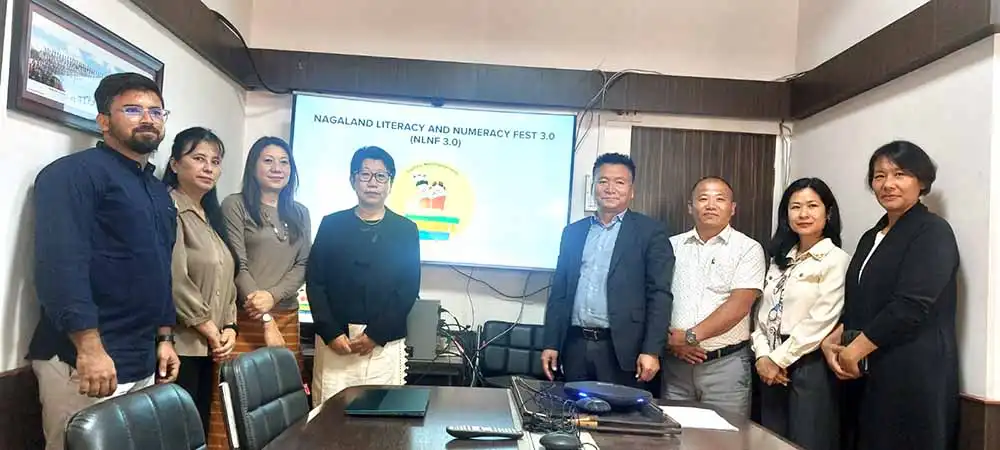
Nagaland Literacy & Numeracy Fest (NLNF) 3.0, a Micro Improve-ment Program for schools in Nagaland, was announced on Tuesday by Kevileno Angami, Commissioner & Secretary of School Education and SCERT.
Addressing media personnel from her office chamber, Kevileno informed that NLNF 3.0 will officially commence from May 1 through the DIKSHA portal, targeting teachers and school heads of all schools that have foundational classes—Pre-primary to Grade 3.
The announcement was made in the presence of Jamithung Lotha, State Mission Director of Samagra Shiksha, Syed Hyder Ali, Senior Lead of ShikshaLokam, Bangalore, as well as offi-cials from SCERT, the directorate of School Education, and Samagra Shiksha, Nagaland.
Kevileno informed that during the academic year 2025–26, NLNF 3.0 will be implemented in five cycles, with thematic projects such as Tales and Stories, Read-a-thon, Literacy Fest, Speak-a-thon, and Write-a-thon for teachers.
She also informed that heads of schools will undertake projects focused on Parental Engagement and school processes that contribute to the achievement of Foundational Literacy and Numeracy (FLN) in government schools.
She described the Micro Improvement Program as a transformative initiative designed to encourage school-level innovative practices and the creativity of teachers through small, ac-tionable steps towards a larger educational goal. According to her, the initiative has been in place in Nagaland since 2022 in collaboration with ShikshaLokam, Bangalore.
Kevileno said the program aligns with the NIPUN Bharat Mission and aims to foster a culture of improved learning outcomes in the foundational stage by empowering educators, enhanc-ing student engagement, and strengthening community involvement across the state.
She noted that participation in the Micro Improvement Plan (MIP) has been steadily increas-ing since its introduction in 2022. On the Annual Status of Education Report (ASER) 2024, she expressed encouragement over the improvement in arithmetic skills at the foundational stage and pointed out a concerning decline in reading levels, particularly among students in private schools.
Kevileno said this is the fourth edition of the Micro Improvement Plan, and added that every activity has been designed in alignment with the academic calendar.
She further emphasized the need for school leaders and teachers to adopt the Micro Improvement approach in class-room practices and school processes to ensure improved and sustainable educational out-comes.