

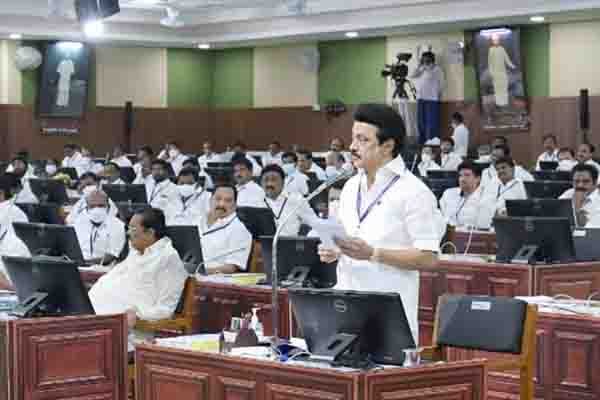
The Tamil Nadu Assembly on Tuesday adopted again, the anti-NEET Bill, returned days ago to the government by Governor RN Ravi and the ruling DMK and principal opposition AIADMK reaffirmed their opposition to the test based on the Dravidian ideology.
Chief Minister M K Stalin labelled NEET a killer exam and said he believed that the Governor would forward without any delay the Bill re-adopted, now to the President for his assent.
“It is the Constitutional duty of the Governor to forward it to the President. I think and expect the Governor to do that duty hereafter at least,” he said.
The Bill was passed followed discussions that stretched to 3 hours and the test was yet again dismissed by Stalin as one that went against the principles of Constitution including social justice and equality.
As per the Constitution, the action of Ravi in sending back the Bill to the Assembly was not a correct decision, the government said. The CM targeted the governor on the return of the Bill and said it raised questions over Centre-state relations. He wondered if the action of the governor in sending back the Bill that was enacted based on a policy decision and which was passed by a duly elected government, did not go against the principle of democracy.
He said the governor was only an appointee, apparently pointing to the supremacy of a duly elected government. If this was the case, “believing whom would the people vote, based on what belief would people vote?” he asked.
Citing the recommendations of the Sarkaria Commission on Centre-state relations, he said the governor should forward a Bill, if it contradicted a law passed by Parliament, to the President immediately for his assent if advised by the state cabinet. The governor must abide by the advice of the council of ministers, he said. The TN Admission to Undergraduate Medical Degree Courses Bill was passed on September 13, 2021 by the Assembly. On Tuesday, it was adopted amid thumping of desks and Speaker M Appavu announced that it has been adopted unanimously.
The Speaker said the Bill would be sent to Raj Bhavan today to forward it to the Centre to get Presidential assent. Stalin implied DMK’s long standing opposition to the institution of governor by citing a remark made in 1967 by party founder and late Chief Minister, CN Annadurai. “I believe that our governor will not create such a situation.” He expressed confidence that Ravi would forward the Bill to the President without any delay.
Stalin apparently slammed the governor for returning the Bill and said by sending it back, the right of Tamil Nadu and the Assembly’s sovereignty have been questioned. It was an attack on the state’s autonomy and the doctrine of cooperative federalism has been turned topsy-turvy and that is a matter of grief and concern, he said. Earlier, the BJP led by its floor leader Nainar Nagenthiran staged a walkout raising its objection to the move. The resolution for the passage of the Bill was piloted by Stalin. The Chief Minister, referring to the communique of the governor on the return of the Bill on February 1, said the reasons adduced by him were not correct.
Ravi, citing the Justice AK Rajan panel recommendations on NEET, said they were based on “guess,” but it was data-driven and based on the opinions furnished by nearly one lakh people, Stalin said.
Reiterating his government’s stand against the qualifying test, the CM said “NEET is not an education system but only a system to coach medical aspirants.” The test favoured private coaching institutions which collected lakhs from students.
“We are seeking exemption from NEET for the sake of students who could not spend so much money to get coached,” Stalin said.
NEET obstructed the education right of poor and ordinary students. He pointed to the national test related irregularities and arrests which also includes impersonation and a CBI case. NEET, which witnessed bungling, was brought to sideline poor and ordinary students in the name of qualification.
“That is why we are opposing it and seeking exemption. Rather than a test, it is a killer of students. It is not a test but an altar,” he said and referred to aspirants including Ariyalur Anitha who had died by suicide after failing to crack the test.
NEET sent some students to grave and others to jail, he said and wondered if such a test was needed.
Stalin said the Assembly had laid foundation for social justice a century ago and referred to the Justice Party capturing power in 1920. “Some think that only social justice is a gift of the Dravidian movement. But state autonomy is also the movement’s gift.” NEET went against social justice and equality enshrined in the Constitution, he added.
In his remarks, Health Minister Ma Subramanian, citing the Constitution, said that the governor unilaterally sending back the Bill and him giving his opinion on the Justice AK Rajan panel report were not correct. He recalled that in 2006, (DMK government) entrance examinations for professional courses including medicine were done away with by passing a law which had received Presidential assent.
He gave point by point answers to aspects flagged by Ravi while returning the Bill to the government. Ravi labelling views of the panel as ‘guess’ was wrong and tantamount to insulting the committee, he said. Pointing to a Supreme Court judgment he said the state has powers to enact law to exempt the state from the ambit of NEET and appealed to the House to adopt the Bill unanimously.
During the discussion over the Bill, the House witnessed din twice when AIADMK’s C Vijayabaskar, Health Minister in the previous regime, traced the origin of the National Eligibility cum Entrance Test to the Congress-led UPA era in 2010 which was opposed by the Congress members. He said the issue should not be politicised and the matter has to be evaluated by legal experts.
Vijayabaskar said his party stood firm in its opposition to the NEET and pointed to the 7.5 per cent reservation for government school students in medical admissions. As early as 2005, during the then AIADMK regime led by late J Jayalalithaa, it was decided there should be no entrance test at all for admission to professional courses. A Government Order was also issued in 2005 this regard. However, it was challenged in a court subsequently and that order was struck down and the DMK assumed power later in 2006, he said.
The AIADMK legislator underscored that his party, in keeping with its Dravidian ideology had opposed entrance tests.
When the Congress party opposed Vijayabaskar’s remarks related to NEET’s origin, Leader of the Opposition, K Palaniswami said that his party colleague was only stating the fact. In view of defamatory campaign against the AIADMK over NEET, his party has to provide answers to claims made.
Stalin and Leader of the House, Water Resources Minister Duraimurugan said the Bill be adopted unanimously once again and urged discussions accordingly.
Before leading the walkout, Nagenthiran said his party had opposed the anti-NEET Bill last year itself and hence it could not be said that it was passed last year unanimously. Duraimurugan said the Bill was supported by all those who were present, and thus it was adopted unanimously.
MLAs including Poovai Jaganmoorthi spoke on increasing the 7.5 per cent quota to government school students up to 15 per cent. Legislator Easwaran sought 30 per cent reservation to students who pursued state syllabus. Barring the BJP, which has 4 members, all others supported the Bill.