

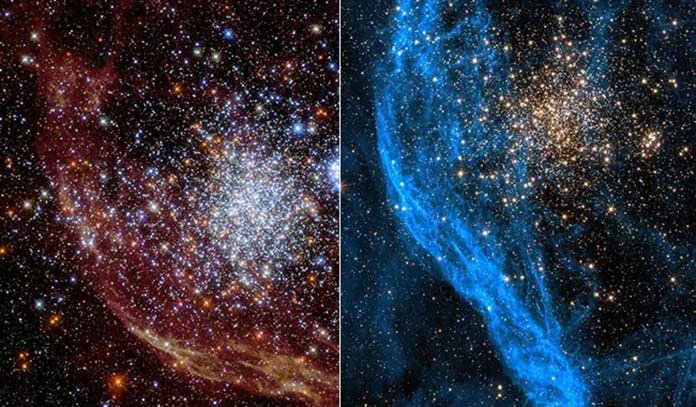
NASA’s Hubble Space Telescope recently captured dual views of an unusual star cluster. American space agency NASA has shared photos on Instagram of a “globular cluster”, which contains thousands of glittering stars from the universe. The cosmic object is located 160,000 light-years away. Although Hubble took both images, different filters were used to study different wavelengths of light emanating from these objects, according to a press release by NASA.
The release further said that the image with blue nebulosity includes some near-infrared light along with visible light (what our human eyes can detect), whereas the image with red nebulosity (also a different “pointing” at the same object) covers a much broader range from the near-ultraviolet to the beginnings of the infrared spectrum. Ultraviolet observations are ideal for detecting the light from the hottest and youngest stars, as seen in this luminous, starry view.
The American space agency informed that this 100 million-year-old globular cluster is located in the Large Magellanic Cloud, a satellite galaxy of the Milky Way. Typical of globular clusters, it is a spherical collection of densely packed stars held together by mutual gravitational attraction. Unlike most globular clusters, these stars are relatively young.
Astrophysicists theorize that when the first generation of these stars in NGC 1850 was born, they ejected matter like dust and gas into the surrounding cosmos. (World News)