

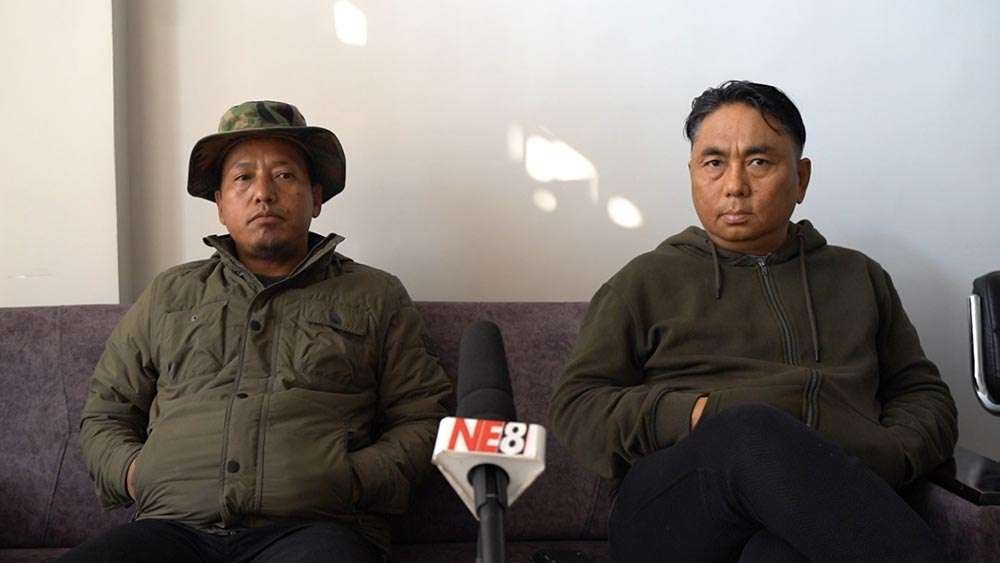
NSCN/GPRN (K) ato kilonser ‘col.’ (Retd) Isak Sumi, who is also the co-convenor of the Working Committee, Naga National Political Groups (WC/NNPGs), expressed concern over the decision of the Central government to abrogate the Free Movement Regime (FMR) and erect fencing along the India-Myanmar border.
In an exclusive interview with Nagaland Post on Saturday, Isak said that such a move would undermine and be an attempt to nullify the “Agreed Position” reached between the Government of India and the WC/NNPGs.
According to Isak, the “concluded negotiation and agreement” (Agreed Position) had categorically mentioned the extension of the FMR beyond the existing 16 km to 35 km, rather than its abolishment. He emphasized that any attempt to abrogate the FMR would contradict the already agreed-upon terms with the government of India.
Isak firmly stated that Nagas live as a cohesive family and opposed any imposition of boundaries that could divide them. While acknowledging that the abrogation of FMR is still in the proposal stage, he expressed optimism that the government of India would consider the complexities of the unfenced border before making any decisions.
He further noted that the problems in Manipur should not become a burden for the Nagas.
While denouncing the recognition of the boundary, Isak stated that it (boundary) is like an imaginary line, forced on the Nagas without their consent and approval.
Isak drew parallels with the Berlin Wall, cautioning against the forceful erection of a wall along the Indian border, stating that Nagas would explore every avenue to prevent artificial boundaries. He said that the collapse of the Berlin Wall was an example of how families and nationalities could not tolerate the divisive measures.
Hypocrisy, self-contradiction and pride hampering unity
In a critical analysis of the challenges hindering a united front among Naga Political Groups (NPGs) in talks with the government of India, Isak cited issues such as “hypocrisy, self-contradiction, pride, and ego.”
When asked about the possibilities of NPGs coming together for talks under one umbrella, Isak stressed the need to first set aside selfish motives and hidden agendas for productive discussions and solutions.
Regardless of different party/negotiations, he said NPGs should be able to sit together, have discussions, find common ground and work towards a solution.
He reminded the government of India’s position against third-party negotiations, stressing that any group seeking a solution should align with completed negotiations. However, he clarified that this doesn’t mean surrendering to NSCN (I-M) or NNPGs but accepting negotiations in the Naga people’s interest.
Isak expressed concern about the lack of a blueprint or political roadmap from other NPGs besides NSCN (I-M) and NNPG. He urged transparency, calling on all NPGs to publicize their agendas, goals, and objectives if they were genuinely working for the Nagas.
Meanwhile, Alezo Venuh, the envoy kilonser of GPRN/NSCN and coordinator of WC/NNPGs, who was also present, underscored the significant role played by the Forum for Naga Reconciliation (FNR) in its efforts to unite NPGs.
Venuh delved into the events surrounding the January 14, 2023 declaration, where the top leadership, President of NSCN (I-M) Q Tuccu, and Convenor of WC NNPGs Kitovi Zhimomi, had signed a declaration to cooperate on both the Framework Agreement and Agreed Position, working towards a solution. However, Venuh expressed surprise and concern that the NSCN (I-M) nullified the declaration without providing any justification till date.
Successful negotiation requires understanding each other’s position:
Highlighting the bilateral nature of negotiations, Isak emphasized the need for mutual understanding, inclusivity, and pragmatism in reaching a comprehensive solution for the Nagas.
“Simply trying to impose our wishes and desires does not make a successful negotiation. We need to understand each other’s position,” he stated. However, he clarified that understanding each other’s position does not imply forfeiting our inherent aspirations.
In the context of the prolonged Indo-Naga political talks, Isak conveyed that the bilateral negotiations concluded on October 31, 2019. However, he expressed disappointment over the inability of certain negotiating parties to make progress with the government of India.
He recalled a proclamation by NSCN (I-M) ato kilonser Th Muivah in 2012, where Muivah stated that “sovereignty and integration were no longer possible.” Isak questioned whether NSCN (I-M) was contradicting itself, leaving that assessment to them.
With formal negotiations completed, Isak questioned the transparency of NSCN (I-M) in presenting their “competencies” for public approval.
Regarding Niki-led NSCN (K), Isak acknowledged his lack of awareness about interactions between Niki Sumi and the Government of India, and refrained from commenting.
On the other hand, he maintained transparency in NNPG’s negotiations, emphasizing no hidden agenda. He clarified that NNPGs was not imposing its solution and expected other negotiating parties to exhibit a similar spirit for NPGs to come together for a solution.
He emphasized that with the endorsement and mandate of the Naga people, the negotiation had been successfully concluded, and an agreement is in place, awaiting only the final signing. While acknowledging that the 16 Point Agreement and Statehood were not final resolutions, Isak pointed out that they remained tangible realities.
Similarly, he noted that sovereignty and integration might not be immediately achievable, but the Agreed Position allows room for future negotiations.
Isak emphasized the importance of focusing on achievable goals in the present, underscoring the shared concern of NNPGs and the Naga people for an inclusive, practicable, honorable, and logical solution.
Article 371 (A) should be strengthened
In addressing concerns related to Article 371 (A), Isak shared his perspective, emphasizing that both Article 371 (A) and Statehood for Nagaland were viewed as temporary measures.
He acknowledged that these measures have fallen short of fully meeting the aspirations of the Nagas, resulting in ongoing issues and conflicts.
While Article 371 (A) includes provisions for self-rule, he also highlighted certain ambiguities within the article that have not been fully implemented to their potential. However, he argued against the outright removal or abrogation of the Article, suggesting a need for reinforcement and strengthening.
“Rather than talking about abrogating it, we should be able to re-strengthen and fully implement it”, he said, underscoring the importance of building upon the existing framework.
He further pledged efforts directed towards defending what has already been achieved, emphasizing that aspiring for higher goals does not imply relinquishing existing gains. Isak clarified that the Naga solution revolves around sovereignty and is not solely about Article 371 (A) or a portion of Naga territory granted statehood.
Expressing the broader aspiration of uniting all Naga areas under one complete political sovereign existence, Isak highlighted the importance of preserving Article 371 (A) until a comprehensive objective is achieved. He emphasized that the article has provided essential protection to the rights of the Nagas.