

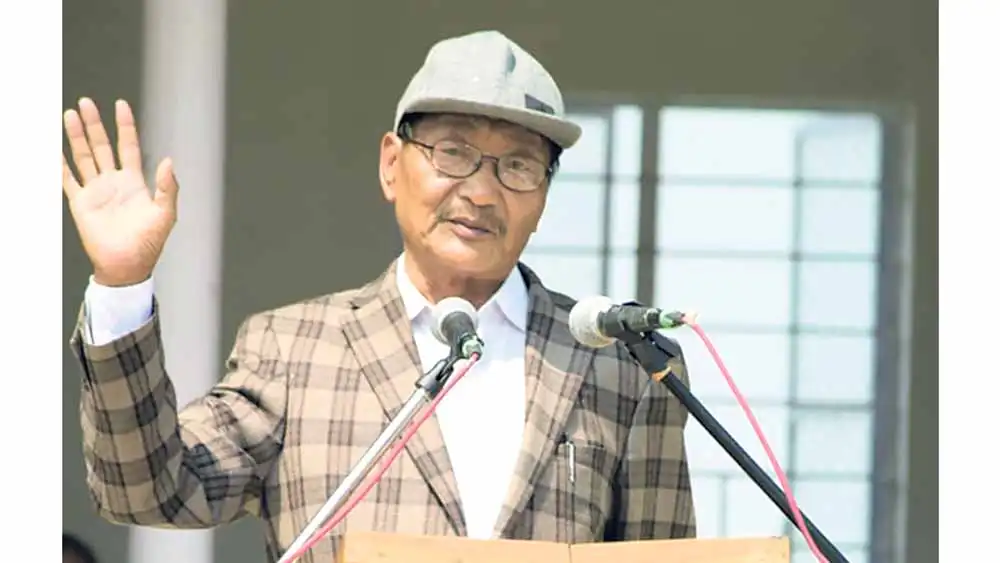
CF extension without my consent: Neokpao
GPRN/NSCN (Unification) president ‘gen’ (retd) MB Neokpao Konyak Sunday maintained that the recent ceasefire extension by the Central government under the name GPRN/NSCN Neokpao-Kitovi (NK) was done without his consent.
In a statement, Neokpao said that he did not authorize G Naga (Ghukiho), team leader, or Chuba Tungoe, secretary, to pursue the signing or extension of the ceasefire under his leadership and maintained that the unauthorised action raised serious concerns about the integrity of the process and potential for further misunderstandings.
Calling to not jeopardising the hard-won progress because of internal disputes or personal agendas of individual leaders, Neokpao pointed out that the stakes were too high. He also said the potential consequences of failure was too dire, to allow petty grievances to derail the pursuit of a lasting and just peace. He reminded that the future of Naga people depended on the ability to maintain unity, uphold the principles of democracy, and work together towards a common goal.
He claimed that the NSCN (U) was registered as the NSCN (NK), representing Neokpao-Kitovi, in the records of the Ministry of Home Affairs. He said this technicality was miscarried over to the extension of ceasefire under the previous position.
Neokpao said the central government was fully aware that the NSCN (U) was firm and united under his leadership as the chairman and Alezo Venuh as ato kilonser, and that all the regions and sub-regions were intact and in position under the council of kilonsers. He stressed that it was crucial that all parties involved recognized and respected the legitimacy of the NSCN (U) under his leadership and adhered to proper entity connotation.
He pointed out that after Kitovi was expelled from the group, he was free to take his own course of decision as he desired. Neokpao said Kitovi should not create any stumbling block against the peace process with the central government.
He mentioned that the NSCN (U) had addressed Kitovi’s acts of nepotism, corruption, autocratic tendencies and bypassing the norms and constitution that led to his impeachment while adding that the leadership never questioned his contribution to the organistation or to the NNPGs.
Asserting that the ceasefire with the NSCN (U) continued, and that Kitovi had taken undue advantages by capitalizing his initials in the records of the central government, Neokpao said that New Delhi would rectify it by all means, and that for such matters the Nagas should not be judgmental on the whole affair.
He also stressed that it was time for Naga leaders to stand together and talk in one voice and pointed out that the political solution with the central government needed a systematic approach.
He stressed on the need to address internal conflicts and disagreements within Naga territories and not air them publicly as such internal discords only weakened the collective position.
Highlighting that this commitment to internal resolution and peace was the driving force behind the NSCN (U) under his leadership, Neokpao asserted that NSCN(U) was striving for reconciliation and a unified front to navigate the complex political landscape.
He recalled the events of March 22, 2025 at Khehoyi camp which underscored the importance of patience and restraint. Neokpao claimed that the group exercised utmost tolerance despite being misled by adversaries who claimed a desire to join the government, and further manipulated by their use of the term “reconciliation” to sow discord and strengthen their position within the camp.
Neokpao maintained that his presence at the Kehoyi camp was instrumental in preventing any outbreak of violence and clarified that this measured response was not borne of weakness or inability to repel the intrusion, but rather from a deep understanding of the potential consequences of internal strife. He said it was a conscious decision to prioritise the greater good and maintain stability.
Calling for learning from past mistakes and avoid repeating patterns of self-destruction, Neokpao recalled that internal conflicts had historically undermined the Naga cause and brought hardship to the people who had placed their trust and faith in the Naga freedom movement. He emphasized that the pursuit of reconciliation required a comprehensive approach, acknowledging the deep-seated divisions that had hampered progress.
According to Neokpao, the Naga struggle, despite being one of the most intense armed conflicts in the sub-continent, had been tragically hampered by internal rifts.
“We have lost leaders not to the guns of the Indian armed forces, but to the devastating consequences of factional feuds fueled by intolerance and undemocratic practices. Our failure to resolve internal differences peacefully allowed the Government of India to exploit these divisions, creating further barriers between us. We must not allow this tragic pattern to repeat itself,” he stressed.
As president/chairman of the GPRN/NSCN (U), he reiterated that he was committed to the principles and spirit of the treaty between the leaders of NSCN (K) and NSCN (I-M), which led to the formation of the neutral balancing force of NSCN (U). He said the agreement paved the way for a ceasefire pact between the GPRN/NSCN and the central government on April 28, 2012 during his tenure as commander-in-chief of the Naga Army, noting that this ceasefire had been extended to the present day.
He maintained that the vision behind the NSCN (U) was instrumental in the formation of the NNPGs in 2016, fostering partnerships with like-minded Naga political groups in the Naga peace talks with the central government. He claimed that the political agreement achieved through arduous deliberations, concluded on October 31, 2019 represented a significant milestone.
As the Nagas lost the opportunity in 1935 at the time of partition of Burma and in 1947 at the time of partition of India, Neokpao said Nagas had to move step by step through political process and disprove the conventions and notions of divisions. He stressed, “The pressure systems that are surmounting the Nagas have to be well taken into account while entering into a political situation.”
He requested the entire Naga people to once again contemplate, understand and extend their support and co-operation towards sincere and genuine reconciliation.
CF temporary arrangement only: G Naga
Staff Reporter
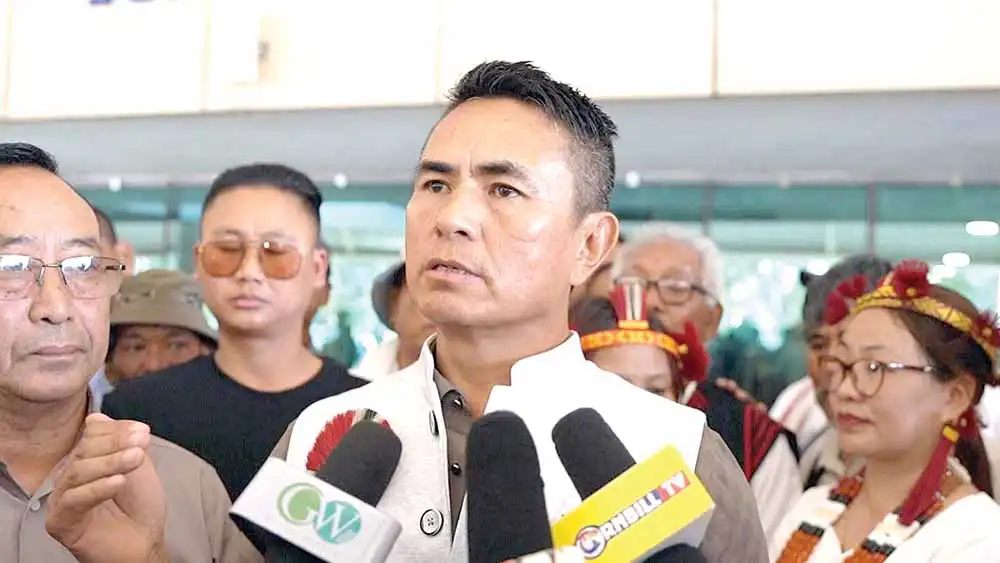
DIMAPUR, APRIL 13 (NPN): Emphasising that ceasefire was only a temporary arrangement, supervisor of Ceasefire Supervisory Board (CFSB), GPRN/ NSCN (NK), G Naga on Sunday maintained that the real achievement would be attaining a lasting and honourable political solution, and not merely in extending ceasefires.
Speaking to media persons at the airport here on his return from Delhi, G Naga said while the ceasefire agreement signed on April 11 with the central government was necessary, it was merely a “one-page document” that could be reduced to a “piece of paper” by this time next year. He emphasized that the real challenge lay in bringing the Indo-Naga peace talks to a logical conclusion that was acceptable and honourable.
G Naga, along with four NSCN (NK) CFSB members, had gone to Delhi and signed the extension of ceasefire agreement on April 11. The delegation held meeting with officials from the Ministry of Home Affairs (MHA), including additional secretary Piyush Goyal and CFSB-CFMG chairman Lt Gen (Retd) Amarjeet Singh Bedi.
Asked about the confusion over the signing party, “NSCN (NK)”, Naga showed documents to the media, including a letter from the CFSB chairman addressed to NSCN (NK) general secretary N Kitovi Zhimomi, informing about the notification by MHA to hold the review/ceasefire extension meeting on April 11, and to depute the group’s CFSB along with credentials to attend the meeting.
He showed other documents, including a credential letter signed by Kitovi, authorising him(G.Naga) and four others to represent the group in Delhi. He said the documents clearly showed the ceasefire agreement was signed under the leadership of Kitovi.
Amidst a huge numbers of national workers present at the airport, he clarified that they were not there to welcome him, but to understand the developments surrounding the ceasefire.
He pointed out that as per the document, it was clear that the CFSB chairman and the MHA had invited the GPRN/NSCN under leadership of Kitovi.
He downplayed the focus on the nomenclature, stating that the question of “NSCN (NK)” did not matter as long as the people were aware to whom the central government had given the official invitation.
Asked on the next step to be taken following signing of the extension of ceasefire agreement, Naga replied that the ceasefire agreement was just a one page document, and was meant to bring the Indo-Naga political solution. He however pointed out that it cannot go on like this.
“To say that ceasefire was very important, I don’t think that is true,” he remarked, adding that the main objective was reaching a solution.
Paying respect to all Naga leaders, including “Uncle M Neokpao”, “Sir Alezo”, and others, he elaborated that the ceasefire was just a mechanism to maintain peace on the road to bringing the Indo-Naga peace talks to a logical conclusion.
He stressed that it was high time for the central government and Naga people to walk the talk on the two agreements.
He claimed that, barring a few, all Naga political groups (NPGs) were in the same trajectory when it came to Indo-Naga political solution and appealed to all NPGs and top leadership to put their heads together and work out the solution.
On the mushrooming of NPGs, Naga maintained that the factions were people’s creations.
However, he said even though there were many factions, those working for the Nagas should put their heads together as soon as their leaders came together in achieving the Indo-Naga political solution. In this way, he pointed out that the issue of nomenclature would go away.
He mentioned that GPRN/NSCN or any nomenclature were secondary because all must come together and look for a solution that was honourable and acceptable to the people.