

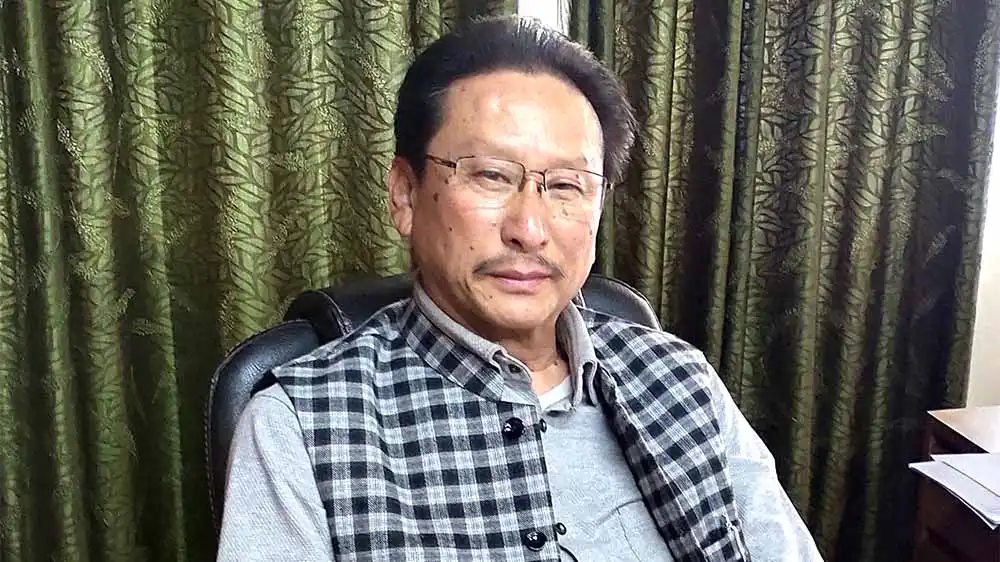
‘Embarrassing, a wake-up call for state govt’, says Kenye
The state cabinet has decided to revoke the controversial regularisation order for 147 appointments under the Department of Higher and Technical Education Wednesday, following an interim report submitted by the High-Power Committee (HPC) constituted to investigate the matter.
Addressing media at his office chamber at Nagaland Civil Secretariat after the emergency cabinet meeting, minister of Power and state government spokesperson KG Kenye remarked that the issue was a “wake-up call” for the government as it had caused considerable embarrassment to the cabinet.
He informed that the cabinet had received the interim report of the HPC Wednesday after much deliberation at different levels. He said the government has to rely on the report of the HPC which was yet to establish the presumptions and assumptions after which action will be taken.
Kenye said the actions will depend upon the nature and degree of anomalies, whether deliberate to further probe the findings. It may be recalled that the HPC was formed on April 21 as the cabinet felt the matter warranted immediate re-examination after the controversy surfaced.
Although the committee was initially given eight weeks, it was later reduced to four weeks after an emergency cabinet Meeting on Monday, to submit its findings. The escalating tensions prompted the HPC to fast-track its assessment and submit an interim report on Wednesday.
Kenye stated that the cabinet, upon reviewing the interim findings, was convinced that procedural anomalies had indeed occurred, and therefore resolved to revoke the regularisation order. He expressed the hope that the decision would convince the aggrieved parties withdraw their agitation and allow the government to await the final report and after which a comprehensive decision would be taken based on the report.
He reiterated that the government could not act solely on assumptions or public pressure, and base its decisions on substantive evidence and procedural justice. “Natural justice requires facts before any reversal of decisions,” he remarked.
Kenye acknowledged that the initial action of the cabinet- keeping the order in abeyance-was made under presumption. He said it was “very rare for the cabinet to revoke its own decision. This is an extraordinary step, and very embarrassing.”
Kenye admitted that as the cabinet is the highest policy and decision making body it was “very embarrassing for the cabinet to revoke its order”. Kenye said he does not recall any cabinet decision being kept in abeyance or even revoked.
He expressed the hope that based on the interim report of the HPC, the government “will not be wrong in revoking the decision.”
In a startling admission, Kenye said regularization had not been brought to the notice of the cabinet until April 21. “There are many ways in which departments can proceed without the knowledge of the government. If any action is contrary to a cabinet order, it should not be pursued, but in this case, it escaped our notice,” he stated.
He also said the government had been trying to persuade aggrieved parties, including student leaders, to withdraw their agitation as the matter could be resolved through institutional processes. He however acknowledged that the lapses committed by the department had misled the cabinet and placed the government in a difficult position.
Expressing relief that no untoward incident occurred during the agitation, he appreciated that the protesters had exercised restraint and the district authorities had responded promptly to maintain law and order, even though the government had feared potential violence.
He highlighted the gravity of the situation by noting that it concerned one of the most challenging sectors in the state — employment. “Nagaland has one of the highest literacy rates in the country, but ironically also has one of the highest unemployment rates,” he pointed out.
On whether the interim HPC report would be made public, Kenye replied that the government believed in transparency. However, he stressed that final decision would be made only after the HPC completed its investigation and submitted the final report.
He also hinted that the 147 regularised posts could be segregated into two or three categories based on the cabinet decision of June 6, 2016 as such classification might help in arriving at an amicable and just solution. Until then, he assured that the individuals would remain on contract, and status quo would be maintained.
He admitted that the situation could be just a “tip of the iceberg”, and did not rule out similar practices in other departments. He however assured that the cabinet would not sleep over such issues again, urging all directorates to be serious in adhering to government orders and rules, adding that the same standards would apply to all departments henceforth.
He said chief secretary J Alam would be issuing a formal order soon to provide further clarity on the matter. On why the government acted only after protests began, Kenye admitted that the cabinet initially believed everything was in order.
“We function on trust and expect those in high positions to perform their duties responsibly. It was only after the aggrieved parties expressed concern that we realised something was wrong,” he said.
On how the cabinet viewed the recent statements and commitments made by the minister concerned over the issue, he remarked it was “annoying”.
He reaffirmed the government’s commitment to correcting the lapses and delivering justice through due process, expressing hope that peace and normalcy would be restored.
Chief secretary’s notification
As per a notification, the Governor of Nagaland, in supersession of the department’s earlier notification dated April 21, 2025, has revoked the absorption orders dated December 17, 2024 and April 10, 2025. The revocation takes immediate effect.
The notification (HTE/HE/134-3/2020 (Pt-11) was issued from the chief secretary Dr J Alam’s office, and stated that the decision was made with the approval of the cabinet decision (No. CAB-1/14/2023 dated April 30, 2025).