

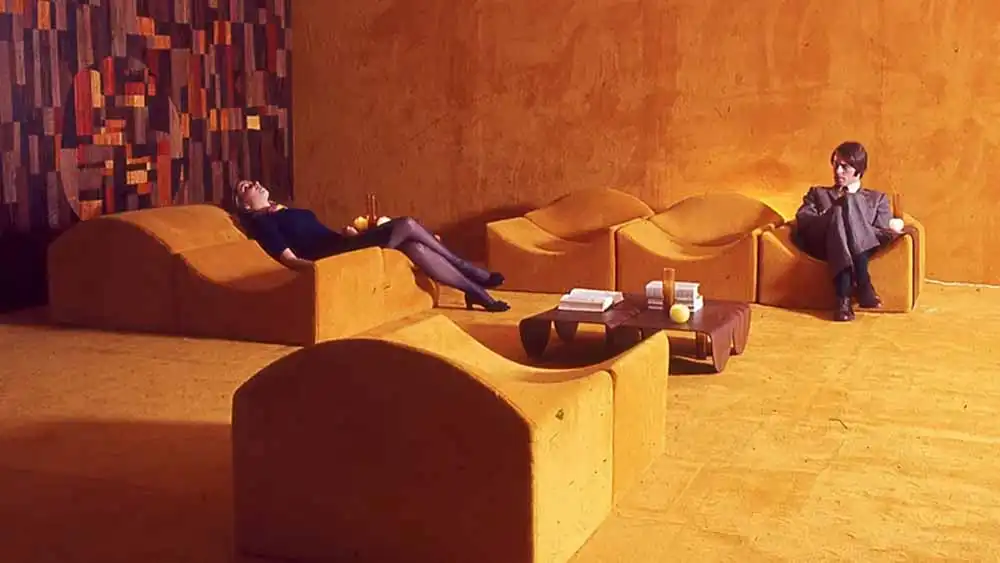
Space-age style is skyrocketing in pop culture – in celebrities’ homes, at global design fairs and even in blockbuster films. We look back at the stunning retro-futuristic origins of 2025’s biggest interiors aesthetic, and ask, why now?
From aerodynamic cars to voluminous moonscape-style seating, popular culture and design is going cosmic. Some architects, designers, film-makers and galleries are looking, if not to Star Wars’ “galaxy far, far away”, then at least beyond the Earth’s atmosphere for their inspiration.
Coming out in July, Marvel Studios’ latest film, The Fantastic Four: First Steps, boasts a living room with a circular sunken sofa arrangement and glossy white circular side tables, and cars with oversized fins. Not your typical styling for an action-adventure blockbuster.
Down here in the real world, some major US interior designers have made the space-age aesthetic highly fashionable. LA- and Milan-based Giampiero Tagliaferri is among the designers who espouses a “California Space Age” aesthetic for the homes of tech moguls, art collectors, fashion creatives and pop stars. One such has a shiny white futuristic spiral staircase that wouldn’t have been out of place in Stanley Kubrick’s 1968 film, 2001: A Space Odyssey.
And US interior designer Kelly Wearstler’s own Malibu beach house is full of space-age design, like the 1970s sofa and chaise longue by Afra and Tobia Scarpa, and the 1957 Digamma chair with its four splayed feet by Ignazio Gardella.
Meanwhile, furniture brands like Paulin, Paulin, Paulin have been quick to spot a trend, or perhaps are leading it. The family business is reissuing space-age designs from the early 1970s by influential French furniture designer Pierre Paulin.
In particular, his Dune Ensemble modular seating arrangement with its echoes of a planetary surface has become a favourite among music-industry types and influencers. Famously private singer Frank Ocean, Red Hot Chili Peppers bassist Flea, rapper Travis Scott, Justin Bieber and Kim Kardashian are all reported to have one.
Galleries and design fairs are picking up on this retro-futuristic nostalgia. On show at Vitra Design Museum in Germany’s Weil am Rhein is Science Fiction Design: From Space Age to Metaverse. It explores how the designers of the Space Age supplied film directors with the ideal furnishings for their science fiction movies: Olivier Mourgue’s 1960s Djinn seating series in 2001: A Space Odyssey; Eero Aarnio’s 1971 Tomato Chair in Barry Sonnenfeld’s Men in Black (1997); and Paulin’s 1966 Ribbon Chair in Denis Villeneuve’s Blade Runner 2049 (2017).
At this spring’s Milan Design Week, the hottest ticket was for the installation created by fashion house Loro Piana and the achingly cool furniture designers Dimorestudio. In La Prima Notte di Quiete, they presented a kind of idealised cinematic 1970s apartment which was pure Italo-Californian space-age chic: sunken conversation pits, round beds, cascades of cuboid wall-lights, retro seating, electric green carpet. (BBC)
Space-age styling was also on display at Brussels’ vast Brafa Art Fair. Each year, Delen Private Bank, which has an extraordinary collection of Modernist art and mid-century furniture, creates a suite of rooms at the fair as the ultimate apartment.
This time, its sassiest room was pure space age – red gloss walls redolent of Verner Panton’s Visiona exhibitions, with that most space-age of symbols: the Joe Colombo Elda Chair.
The origins of space-age style This aesthetic has its roots, of course, in the first space race, which set off when the Soviets launched the Sputnik satellite in 1957, and continued throughout the 1960s with Nasa’s Apollo programme.
These events dominated the global media, and people across the world uncynically embraced the idea that humanity had entered a new era. “It seemed only natural that objects and spaces should reflect this,” Peter Martin, author of Space Age Design: Icons of the Movement, tells the BBC.
With that backdrop, pre-war design and architecture suddenly looked out of date. Instead, the height of cool was the forward-looking sophistication of Eero Aarnio’s 1963 Pallo or Ball Chair, ideally placed within a modernist home