

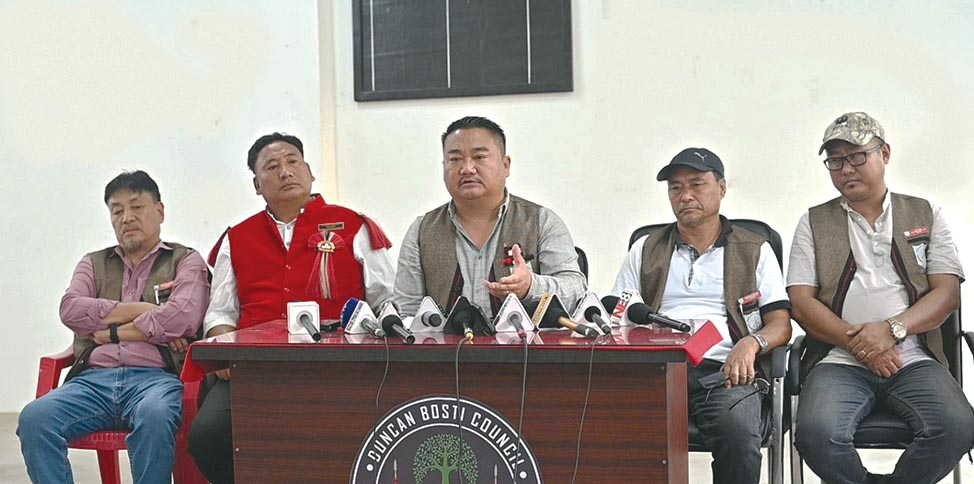
A joint meeting of Dimapur Urban Council Chairmen Federation (DUCCF), GB Union Dimapur Sadar (GBUD), and Dimapur District GB Association (DDGBA) held on Tuesday at the Duncan Council Hall, voiced serious concerns over the manner in which the prepaid electricity metering system is being implemented in Dimapur.
Briefing the media, Dimapur District GB Association president K. Hokuto Zhimomi stated that although the prepaid metering system was introduced in 2024 in select areas such as Marwari Patti and other commercial localities, the government’s plan to expand the system to 16,000 units within one year across Dimapur by 2025 may not be practical unless critical groundwork is completed.
Hokuto clarified that the CSOs were not against the government’s initiative or the Power department, but were appealing for a more considered and inclusive approach.
He highlighted issues such as outdated transformers in 97 colonies, need for proper installation of electric poles, and replacement of old aluminum wiring, which must be addressed before full-scale implementation.
He lamented that their appeal was misinterpreted by the government, which responded with taking “strict and suitable action” against any Gaon Buras (GBs) who oppose the implementation of prepaid meters, treating them as if they had committed some wrongdoing.
Reiterating their support for reform, Hokuto emphasized that the implementation should consider the needs of economically weaker section of the society. He also pointed out that while Nagaland has 17 districts, the prepaid metering is being aggressively pursued only in Dimapur.
He urged the government to prioritize the metering initiative in government offices, industrial zones, and commercial establishments, where bills have been pending for over 15 years, before targeting domestic consumers.
Hokuto added that the government should first assess whether privatizing this system would indeed lead to better revenue generation. Awareness campaigns and seminars, if conducted earlier, could have prevented the current tensions, he said.
DUCCF president Zasivikho Zakiesato echoed the sentiment that the CSOs do not oppose the prepaid system but demand public sensitization and education.
He said most shops already have prepaid meters and called on the government to begin implementation in a phased and transparent manner.
He also expressed concern that the state was attempting to derecognize GBs and colony chairmen, despite their role as voices of the public, especially prior to the conduct of Urban Local Body elections.
DUCCF vice president Wojamo Yanthan remarked that in the absence of a political opposition in Nagaland, civil society organisations (CSOs) have assumed a role akin to the opposition in addressing public concerns.
He questioned why, out of Nagaland’s 17 districts, the prepaid metering system was being aggressively pushed only in Dimapur. He pointed out that the system is part of a central government directive which clearly outlines that prepaid meters must first be installed in government offices, industries, and other government buildings by December 2023, with public sector implementation to follow by March 2025.
Given this timeline, Wojamo asked whether the government had complied with the first phase of implementation as mandated. He stressed that proper maintenance and groundwork were essential, and that prepaid meters for the public should only follow successful implementation in government institutions.
He acknowledged that prepaid meters had already been installed in Dimapur to some extent and that owners of large commercial buildings were being asked to install transformers. However, he appealed for more time before extending the system to domestic consumers. Wojamo also urged the department to avoid forcing consumers to implement prepaid meters in residential colonies, warning that such an approach could cause unnecessary tension and misunderstandings.
On the department blaming consumers for non-payment of bills, Wojamo said the GBs had asked the Power department to report any irregularities so that they could take action. However, he asserted that the public was generally paying their dues regularly and only the department knew the real reason behind the electricity revenue deficit.
The associations also raised concern over the increase in sanitation fees from Rs. 60 to Rs. 80 after the ULB elections, while garbage collection frequency dropped from three to four times a week to once a week. GB Association president questioned the rationale behind the hike despite the centre releasing funds, implying a lack of transparency.
On the Midland Council controversy, DUCCF finance secretary Akusu Zeliang clarified that the dispute had been resolved after deliberation between DUCFF and the Midland Colony Council. He said the council was functioning after reaching mutual understanding.
Regarding issues concerning Government Middle School (GMS), Midland, Akusu said that further discussions were expected. He assured that DUCCF was committed to constructive dialogue and would submit a formal request to the Dimapur Naga Students’ Union (DNSU) seeking more time for the Midland Council to stabilize. He informed that the fact-finding committee constituted earlier would continue to investigate and address the school-related matter.