

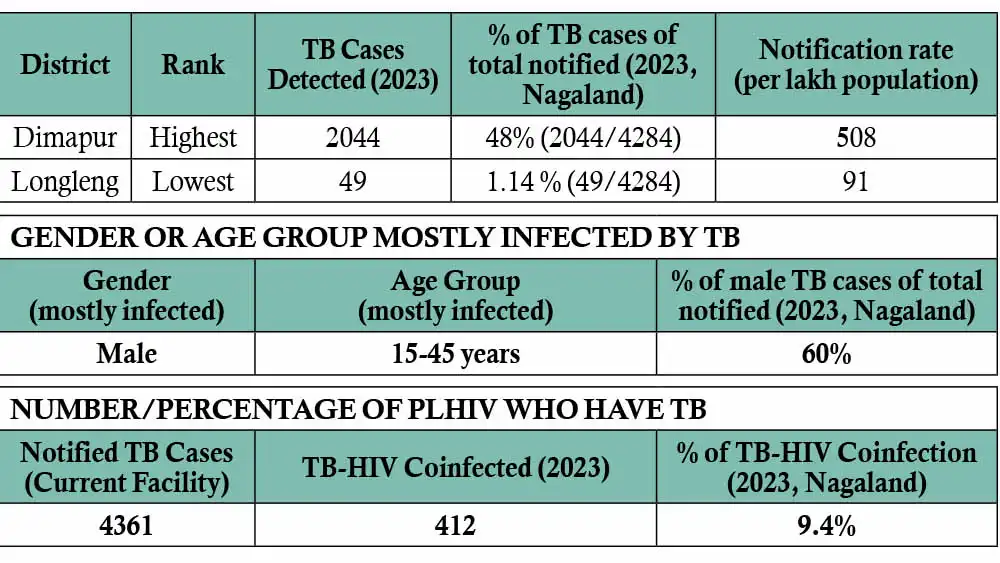
Accounting for 48% of all notified cases and with a notification rate of 508 per one lakh population (compared to Nagaland’s average of 204 per one lakh population), Dimapur had Nagaland’s highest burden of TB cases in 2023. Conversely, Longleng had the lowest burden, constituting only 1.14% of the total notified cases in Nagaland and with a notification rate of 91 per lakh population. Altogether, 49 TB cases were detected in the district and males in the age group 15-45 accounted for 60% of all TB cases among the total notified cases in the state.
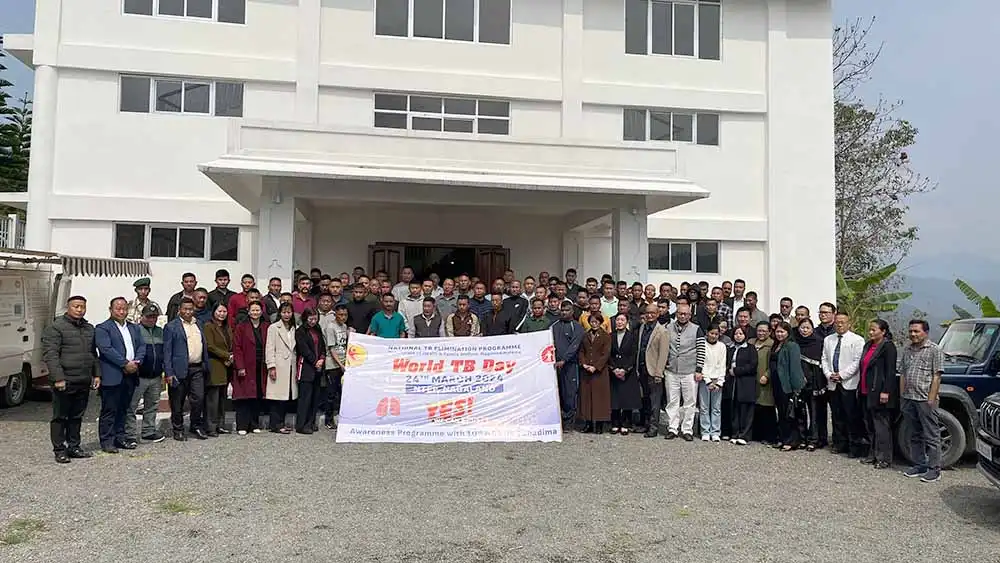
These facts were revealed by National Tuberculosis Elimination Programme’s (NTEP) state TB officer Dr Vezokholu Theyo during a programme held at the multi-purpose hall of 10th NAP (IR) Zhadima on Sunday to mark the World Tuberculosis Day.
Organised by the NTEP, the function was held on the theme “Yes we can end TB”.
Theyo disclosed that the National TB Prevalence Survey from 2019 to 2021, which included data from the North-eastern region including Nagaland, indicated a prevalence rate of 276 TB cases per lakh population for individuals aged 15 years and above, and 274 per lakh population for all age groups combined.
Claiming that these rates were slightly lower than the national average, she revealed that TB cases notified in 2023 in Nagaland amounted to 86% of the target set at 5,000, resulting in a notification rate of approximately 204 per lakh population (with 4,284 active TB cases reported in 2023).
She stated that TB case notifications initially increased, but declined during the Covid-19 pandemic, reflecting both upward and downward trends over the past five years. In post Covid-19 year of 2020, TB cases showed an upward trajectory but were yet to reach pre-Covid-19 levels observed in 2019.
Theyo claimed that the state was working on and implementing key strategies to become TB free by 2025 based on the National Strategic Plan (NSP), including Sub-National Certification (SNC). She said TB-free districts would undergo annual surveys to assess reductions in TB burden, aiming for SNC and TB-free status.
She mentioned that high-performing districts such as Dimapur, Peren, Longleng, Phek, and Zunheboto received incentives and rewards for meeting targets.
She revealed that about 10% of villages in Nagaland had submitted claims for TB-free status, while 78 villages across 11 districts had been certified as TB Mukt Panchayat. Further, stating that TB screening through an artificial intelligence-powered cough detection programme was being implemented in collaboration with the Johns Hopkins Program for International Education in Gynaecology & Obstetrics (JHPIEGO) and Wadhwani Institute for Artificial Intelligence, she said the initiative supported community health officers (CHOs) and medical officers (MOs) in screening individuals visiting Health & Wellness Centres (HWC) outpatient departments (OPDs) for potential TB cases using a cough AI-powered application. Initially piloted in Dimapur, Mon, Mokokchung, and Kohima districts, she said the programmed aimed to expand to cover all districts in the future.
Commenting on the Health & Family Welfare (H&FW) Department’s efforts to raise awareness about the connection between TB and HIV, she highlighted the TB-HIV collaborative mechanism, including the state and district-level TB comorbidity coordination committees chaired by H&FW commissioner & secretary, she said these committees oversaw the implementation and review of collaborative activities.
She emphasised TB-HIV service integration, information system integration, joint planning, supervision, and monitoring visits, besides partnership engagement with NGOs.
Speaking on the theme “Yes we can end TB”, World Health Organisation (WHO) medical consultant Dr Collins Z Sono emphasised addressing TB, describing it as a significant global threat that was often referred to as “the robber of youth”.
He said the disease claimed lives of up to 4,400 people daily and affected nearly 30,000 others, while noting the remarkable progress made in combating TB since 2000, with an estimated 75 million lives saved worldwide since then.
He cited the latest global TB report of 2023 to state that India faced a substantial burden, contributing to 26% of new cases and 30% of deaths globally. With an estimated 35-40 crore individuals in India having TB infection, there was a pressing need for action, Sono emphasised. He said 5-10% of those infected develop TB disease within two years of initial infection.
Hoping that TB would be combated through strong leadership, increased investments, and implementing new WHO recommendations, he stressed that efforts should focus on providing access to new diagnostics, treatments, digital technologies, and artificial intelligence, besides engaging with communities and civil society.
He underscored political commitment to accelerate progress, emphasising comprehensive care for affected individuals and collective responsibility to address inequalities. Sono also highlighted the impact of Covid-19 pandemic, which exacerbated existing disparities in healthcare access. He said people with TB, who were among the most marginalised and vulnerable, faced significant challenges in accessing healthcare.
He called for action to tackle health inequities for those affected by TB, stressing collective efforts to end this preventable and curable disease. Speaking on the occasion, H&FW director Dr Akuo Sorhie expressed gratitude for being present in Zhadima, considering that she was the first doctor posted there when it was a small dispensary, before being upgraded to a subsidiary health centre 30 years ago.
She expressed solidarity with millions affected by TB annually and remembered those who lost the battle, urging everyone to take individual responsibility in fighting this preventable and curable disease and aim to create a TB-free state.
Acknowledging TB as one of the deadliest diseases globally, she noted the alarming rise in drug-resistant variant, while appreciating NTEP, health workers, treatment supporters, ASHAs, CHOs, and TB champions for their tireless efforts.
She reminded the audience that the battle against TB continued, urging them to become ambassadors and disseminate knowledge about the disease across Nagaland and the nation.
With India’s commitment to eliminate TB by 2025, she stressed political will, support, and leadership, along with community and individual involvement in this regard. She urged anyone with TB symptoms not to wait but seek immediate medical consultation, highlighting that it was curable.
Speaking on behalf of the Response from 10th IR (NAP), a representative expressed gratitude for the insightful programme on TB disease and extended his appreciation to the organisers. He hoped that the programme had addressed doubts of the participants regarding the stigma associated with TB.
TB survivor to TB champion, Neilakie, a 19-year-old, recounted her personal journey with the disease and the challenges she faced on her path to recovery.
The programme was chaired by NTEP state information, education & communication (IEC) officer Thungchanbeni M Humstoe, invocation by Zhadima Police Baptist Church pastor Rev Toshi and vote of thanks by state PPM coordinator Temjenochetla Ao.