

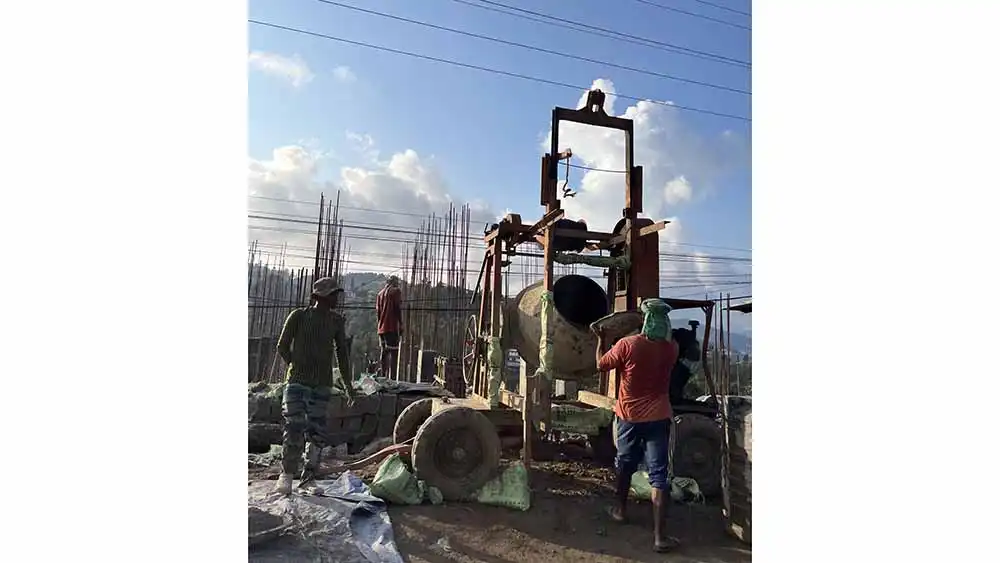
The supply chain in the construction industry faces multiple challenges because of various factors. Neiphrezotuo Tsiekha, a supplier of construction materials, highlighted two primary challenges — illegal tax collection and poor road conditions.
He claimed that illegal taxes caused a heavy financial strain on operations, as suppliers often encountered individuals or groups demanding unofficial payments. He explained that this unpredictability complicated budgeting and often eroded profit margins, especially in a competitive market where prices must remain fixed.
Additionally, poor condition of roads impeded transportation of materials and equipment to construction sites. He said bad road conditions and occasional landslides led to project delays, reducing overall productivity, besides contributing to increased vehicle wear and tear, resulting in higher maintenance costs and potential safety hazards for drivers and workers.
Tsiekha stressed addressing these two issues were vital not only for the growth of their business, but also for the overall advancement of the region’s construction industry.
Without this, he cautioned attracting skilled labour and securing necessary resources would become even more difficult, ultimately affecting the quality and timeliness of construction projects. Construction supplies market dominated by non-local suppliers. Noting that the construction supplies market had historically been dominated by non-local suppliers, Tsiekha said this created challenges for local providers trying to establish themselves. Despite this, he acknowledged that there had been gradual progress, with local suppliers beginning to gain traction and expand their reach in the state.
He highlighted that larger non-local companies had long controlled the supply chain, resulting in fierce competition. However, he noted that local suppliers were starting to carve out their own space and were now supplying materials across the state.
He said he was optimistic about the future of local entrepreneurs in the construction industry and believed that, with appropriate training, opportunities, and support, they could achieve success.
Limited opportunities for local labourers: Tsiekha mentioned that he primarily employed non-local labourers because local workers often refused to compromise with their demands. He said this inflexibility often arose from a strong sense of community pride and the belief that local workers deserved fair compensation. However, he pointed out that this rigidity complicated negotiations regarding scheduling, workload, and pay rates.
Pointing out that local labour costs were typically much higher than non-local workers, he stated that local rates were influenced by market conditions, including cost of living and demand for skilled labour.
While it was important for workers to earn a liveable wage, he mentioned that these higher rates created financial strain on construction projects, particularly when budgets were tight. He said non-local labourers offered more competitive rates and were generally more open to negotiating their compensation and work arrangements.
Further, Tsiekha said employing non-local labourers became more convenient because they were often willing to accept lower wages and compromised on their work commitments, adding that the flexibility helped him manage project budgets and timelines effectively.
Additionally, he said non-local workers often brought diverse skills and experiences from various projects in different regions. For instance, he pointed out that even basic tasks such as carrying bricks or other materials required specific skills that many local labourers lacked. He mentioned that non-local workers were also often the more viable option for meeting construction needs and ensuring timely project completion.
He illustrated this point by stating that one non-local worker carried one bag of cement on his head, while it took two local workers to carry the same load.
Utilising local raw materials for sustainable building: Richard Belho, an acclaimed architect and recipient of the Bamboo Pioneer Award from the World Bamboo Organisation, highlighted the significant potential for sustainable development in Nagaland through the use of local resources, particularly bamboo. He cited the rising demand for bamboo both locally and beyond, often resulting in orders that exceeded supply.
He advocated a strategic emphasis on utilising raw materials available in Nagaland, arguing that reliance on imports undermined the state’s economic vitality, while stressing the importance of promoting local labour and sustainable materials to boost cash flow within the community.
To effectively harness resources like stone, wood, and bamboo, he suggested conducting thorough studies to determine optimal harvesting times and locations. He also called for awareness campaigns to educate both professionals and locals, especially in rural areas.
By integrating local materials with modern technology, he maintained that Nagaland could build a stronger economy. Acknowledging that logistical challenges, particularly poor road infrastructure, could drive up costs, Belho argued that redirecting funds typically spent on external construction supplies into local initiatives would greatly benefit the state’s economy, ensuring that resources and revenue remained within the community.
Challenges to find traditional raw materials: Jabou Pienyii, who works on traditional housing projects, noted that a significant challenge in the traditional construction industry was the scarcity of large logs in the area. He said he often had to place special orders for wood due to scarcity in the market, adding that key issues included unavailability of logs and the difficulty in sourcing seasoned wood.
He mentioned that time management was another major challenge, as it was not easy to complete the required work in just a few weeks. While many contemporary styles were emerging, he observed that people often preferred traditional designs, feature-specific and deeply meaningful motifs.
He said while there were many machines available for use today, traditional hand tools were still preferred. He also noted that both labour and materials tended to be quite expensive.
Pienyii believed that a solution to meet the rising demand for logs and wood would emerge soon. But until then, he mentioned that there was little that could be done.
He stressed teaching the younger generations this craft and pass on these skills.
With advancements in technology, he pointed out that the simple wooden works that once catered to the needs of all were accessible only to a select few now. He said these tasks could not be accomplished with just any piece of wood, but required finest logs. If a tree trunk was hollow, infested with termites, or struck by lightning, he mentioned that even the best tree became unusable. He stated that it was no longer just a traditional craft, but had turned into a luxury item that many could not afford today.
This story was reported under the KPC-NOBCWWB Media fellowship 2024