

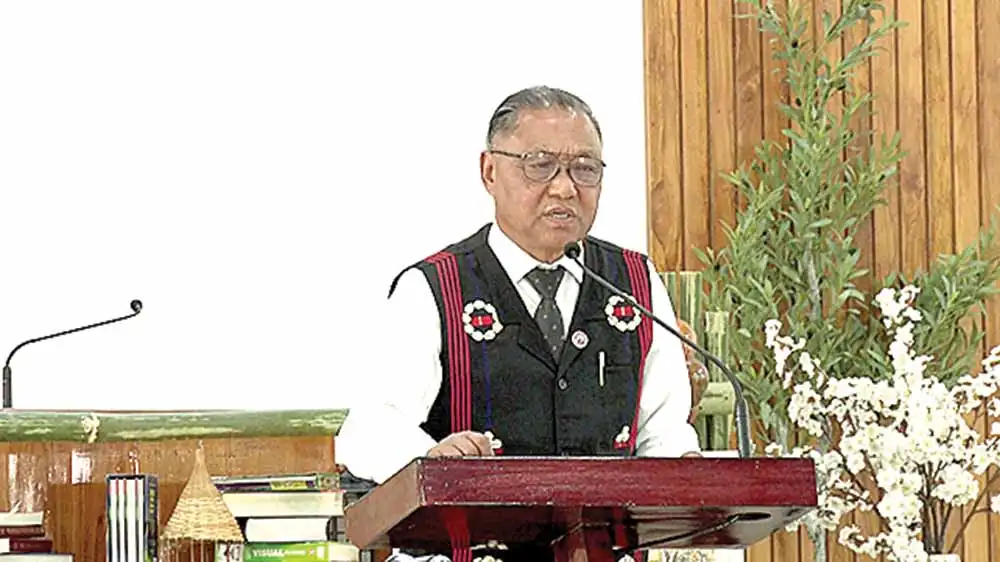
Sümi Literature Board (SLB) celebrated International Mother Language Day, at Sumi Baptist Church, Lake View, here on Friday. The program was organized in collaboration with UNESCO under the theme “Our Mother Tongue, Our Identity”.
Highlights of the event included recognition and awards for Sümi Elders, Award for 2024, HSLC & HSSLC Sütsa subject Toppers and Sütsa Diploma 2024 toppers and launch of the BA Course for MIL academic book.
The book was launched by Ihezhe Zhimo, Dr HD Rotokha and Dr I Lozhevi Sema, while paper presentation was proposed by SLB vice chairman Dr Hotokhii Chishi
Delivering speech, Nagaland State Agricultural Produce and Livestock Marketing Board (NSAPLMB) chairman Inavi Jimo highlighted the significance of speaking in mother tongue.
He considered Sütsa (Sümi language) as precious, explaining that when a message is conveyed in one’s mother language, it touches the heart.
English being the state’s lingua franca, he said that it was vital for translation, and for the use of English alphabet. Jimo highlighted important translated words and urged the gathering to learn the basics first, which are the alphabet and the sounds.
Citing examples from history, of the Babylonians and the Assyrians, he observed that many mother languages are on the verge of extinct, because there were no written form.
He mentioned that Mother language is one’s unique identity, which was related to better cognitive skills, critical thinking, flexibility and problem solving.
While there is a general tendency to label those who speak only in their mother language as ‘aphulomi (villager),’ this mindset has to go, he said. He further encouraged the church and society to organise Sütsa day.
SLB chairman Vihoshe Mürü emphasised the responsibility of preserving and developing Sütsa, the mother tongue of the Sümi community, extends beyond the Sümi Literature Board (SLB) to the entire community.
Citing the Ethnologue guide, he highlighted the precarious state of indigenous languages worldwide, revealing that of the 7,139 officially recognized languages, approximately 40%—including Sütsa—are at risk of extinction by the end of the century.
To counter this threat, he appealed for greater support in the preservation, transmission, and development of Sütsa literature. Elaborating on the formation and evolution of the SLB, Mürü said Sütsa was first documented 119 years ago through the translation of church hymns. While the board operated under a different name initially, the SLB was formally established in 1947, with its golden jubilee in 1997 marking the introduction of Sütsa at the Pre-University level.
At present, efforts are underway to introduce Sütsa at the undergraduate level, with the Higher Education Department currently reviewing the proposal. Once approved, it will be forwarded to Nagaland University (NU) for consideration.
Speaking on the academic challenges associated with introducing Sütsa at the Bachelor of Arts (BA) level, Prof H John Sema, Head of the Political Science Department at Nagaland University (NU), explained that universities follow strict criteria before introducing a new subject.
He pointed out that factors such as student enrollment at the primary, elementary, and higher secondary levels play a crucial role in the decision. If there are insufficient students opting for the subject at earlier stages, its introduction at the university level will be difficult.
Even if Sütsa is introduced in undergraduate programmes, he cautioned that a lack of student interest could lead to its eventual derecognition, which would be an unfortunate setback for the entire community.
Dr H Hotokhü Chishi, Vice-Chairman of the SLB, drew attention to Sütsa’s endangered status. Presenting a paper titled “The Evolution of Sümi Dialect and its Endangerment,” Dr Chishi urged that churches play a proactive role in preserving Sütsa.
Meanwhile, Hoto Yepthomi, convenor of the SLB resolution committee informed that the board has adopted six resolutions including the reaffirmation of Point 3 of its platinum jubilee resolution making the SLB the governing board on all matters related to Sütsa.
The SLB will also have the final say in all and any conflicts arising on this matter, and any individual or organisation coining new words in Sütsa or retranslating words will have to seek approval of the board before publication.
The event also witnessed adoption of resolution, where it was resolved that SLB will coordinate with Sütsa academies to develop a ‘crash course’ for working professionals, church workers or anyone interested in learning the language. It also said that the collection of Rs 10 from every Sümi individual to fund the writing of Sütsa text books would continue in 2025.
It also requested the community to support the only Sütsa vernacular newspaper ‘Sümi Küküptsa,’ so that it continues to flourish. During the event, the SLB recognised and felicitated three Sümi elders—Ihezhe Zhimo, Dr. HS Rotokha, and Dr I Lozhevi Sema— as “Living Heritage”. Citations and awards were also given out to Sütsa language toppers in the 2024 high school, higher secondary examinations as well as Sütsa Academy toppers.
A total of ten books including the BA honours syllabus were also launched to mark the occasion. Exhortation was delivered by Western Sumi Hoho (WSH) president Shikaho Jimo
Greetings message was delivered by Nagaland University department of political science professor H John Sema shared the significance of the Day.
Pioneers speech was delivered by SLB former chairman Dr Hokishe Yepthomi. At the programme invocation was said by Valley View Baptist Akukuhou pastor Rev Avito Chophi, introductory address by SLB chairman Vihoshe Muru.