

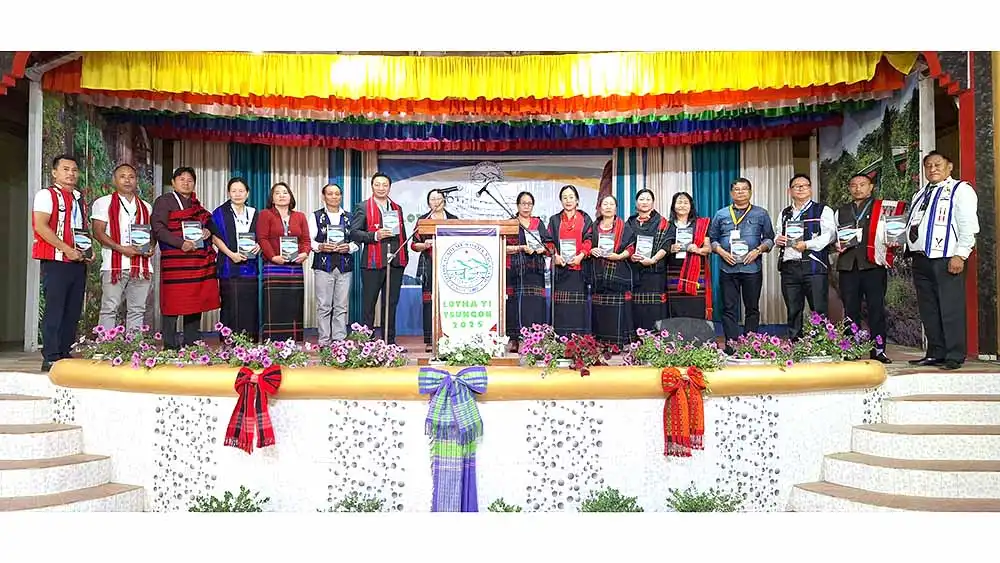
The Lotha Academy observed “Lotha Language Day” on May 1, 2025, at Don Bosco Youth Centre, Wokha, highlighting the rich linguistic and cultural heritage of the Lotha community.
The event was graced by president of the Lotha Officers Association, Orenthung Patton, as the special guest, who underscored the importance of language as a unifying identity marker for the Lothas.
Reflecting on the community’s migration and settlement in various areas, he emphasized that the Lotha language has served as the strongest thread connecting the community over generations. Patton noted that language remains central to cultural identity in the digital era, urging initiatives such as Sunday schools to teach children their mother tongue.
He also encouraged collaboration between the Lotha Academy, Lotha Literature Committee, and church leaders, citing their influential roles within the community. Patton highlighted the contributions of late Rev. N.T. Murry in translating critical materials during the COVID-19 pandemic and acknowledged the challenges of mastering translation, a skill achieved through regular practice.
He also addressed broader challenges faced by Nagas, particularly concerning job opportunities due to the absence of a recognized third language. Efforts to establish such a language are underway, which could enhance employment prospects in sectors like All India Radio and Post Office Dak Sevak posts.
Organizing member Dr. N. Janbemo Humtsoe announced that Lotha Language Day will be officially celebrated annually on May 1 across various locations, including Kohima and Dimapur, to promote the community’s linguistic heritage.
He shared that the Lotha Academy and Literature Committee are working toward introducing the Lotha language as a subject at the undergraduate level. While currently taught up to Class 12, they are seeking approval from Nagaland University to expand its inclusion in college curricula. Dr. Humtsoe highlighted the alignment of this initiative with the National Education Policy, which prioritizes mother tongues at foundational and higher education levels.
In his speech, Lotha Students’ Union president Lirhonthung E. Kithan stressed the significance of preserving the Lotha language as a vital component of identity and culture.
He pointed out issues arising from the existence of multiple Lotha dictionaries, resulting in confusion among students in higher education. Kithan urged the adoption of a standardized version of the language and encouraged students to use the Lotha language actively, underscoring its role in preserving cultural identity.
Chairman of the Lotha Literature Committee, Thungjamo Tsanglao, reinforced the importance of effort and interest in learning the Lotha language. He noted the embarrassment faced by individuals unable to speak or write their native tongue and called upon the community to embrace linguistic learning as the foundation of their identity.
The programme also included the release of the book Lotha Motsüran Ekhvürhyucho (Analogy of Lotha Prose) by the special guest. A folk song competition was held among local schools, with PM Shri GHS Wokha Village clinching first place, Isaiah Ability Hr. Secondary School securing second, and Gilgamesh School achieving third.