

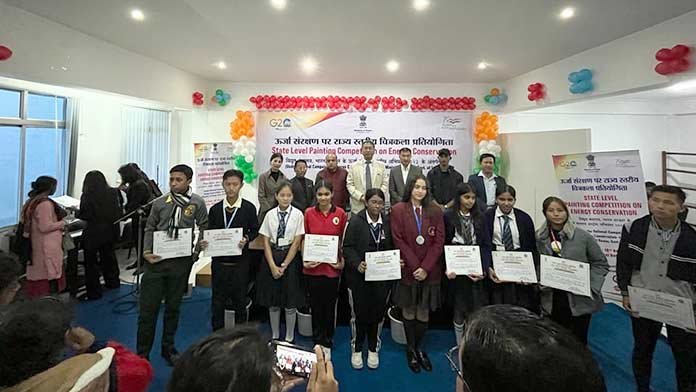
Students were encouraged to adopt sustainable living and make informed lifestyle choices to combat the climate crisis and secure a safe future. The students were also sensitised on behavioural change toward a sustainable lifestyle during the state-level painting competition on “Energy Conservation 2023” organised by Bureau of Energy Efficiency, Ministry of Power, government of India, State Nodal Agency, North East Electric power corporation Ltd., government of India on November 18 at East Gate Hotel, Kohima.
Chief guest of the event, Kohima Science College (KSC) principal, Dr. Temjenwabang briefed the students on energy conservation and subtopics like “LiFE-Lifestyle for the Environment” and “We are pro-planet people.
Encouraging students to adopt sustainable living, he said LiFE movement seeks to transform persons into “pro-planet people”, who would adopt sustainable lifestyles.
Dr. Temjenwabang said “LiFE” serves as a battle against climate change, providing strategies and groundwork for behavioural change toward a sustainable lifestyle. He said the mission aims that by 2028, at least 80% of India’s villages and urban local bodies would become “environmental friendly”.
Deliberating on energy conservation, he said it involved efforts to reduce energy consumption through increased efficient energy use and lower energy consumption.
Dr. Temjenwabang informed that December 14 was declared as “National Energy Conservation Day” by government of India, and that Energy Conservation Act, 2001 established a framework for regulating energy consumption, promoting energy efficiency, and creating standards for appliances, vehicles, industrial and commercial establishments.
With rapid growth in India’s energy demand driven by economic growth, he said it has led to increased greenhouse gas emissions, contributing to climate change and global warming.
Recognising those issues, he said India has committed to reducing total projected carbon emissions by one billion tonnes by 2030 and decreasing the economy’s carbon intensity by 45% over 2005 levels. He said the goal was to achieve 500 GW of non-fossil fuel energy, meeting 50% of energy requirements by 2030.
Stressing that energy conservation could take place in different spheres like domestic, community, industrial, and transportation, Dr. Temjenwabang said at the domestic level, simple changes like lowering refrigerator settings, using energy-efficient bulbs, turning off lights upon leaving rooms, adopting energy-efficient appliances, unplugging devices when idle could be adopted, and shifting to renewable energy sources could result in significant energy savings up to 40%.
He then urged the young students to embrace the role of ambassadors for sustainable living and contribute to the preservation of planet earth. Director of Wotsa Fine Arts & Training Centre, Hekuto Wotsa, who was also a member of the jury, and Head of Power Station, John Zeliang also addressed the students.
Following are the winners — Group A, Anushka Paul from St Mary Higher Secondary School (Dimapur), Debosmita Sarkar from Chitrakala School of Fine Art (Dimapur) and Sreshtha Sarkar from Holy Cross Higher Secondary School (Dimapur) secured the first, second and third prizes respectively. Consolation winners were, Lhuvese Medeo, Shangmeiyenla, Vivika H. Yepthomi, Nikito Yeptho, Sujata Das, Masuma Yamin, Krishtina Singha, Anamika Ghose, Shara Ghosh and Mohit Bhattacharjee. Winners of Group B, Ayushi Bhowal from Livingstone Foundation International School (Dimapur), Zaara Abdul from Hope Academy, and Jhalak Khemani from Holy Cross Higher Secondary School secured the first, second and third prizes respectively.
Consolation winners were, Ripikali H Yepthomi, Bhavya Jindal, Nandant Mahato, Ruchi Rankawat, Shrishant Debnath, Temjensola Walling, Ilokali X Assumi, Ruokuosalie Miario, Imkongsenla, Jekivi Awomi.